
Thunnus alalunga
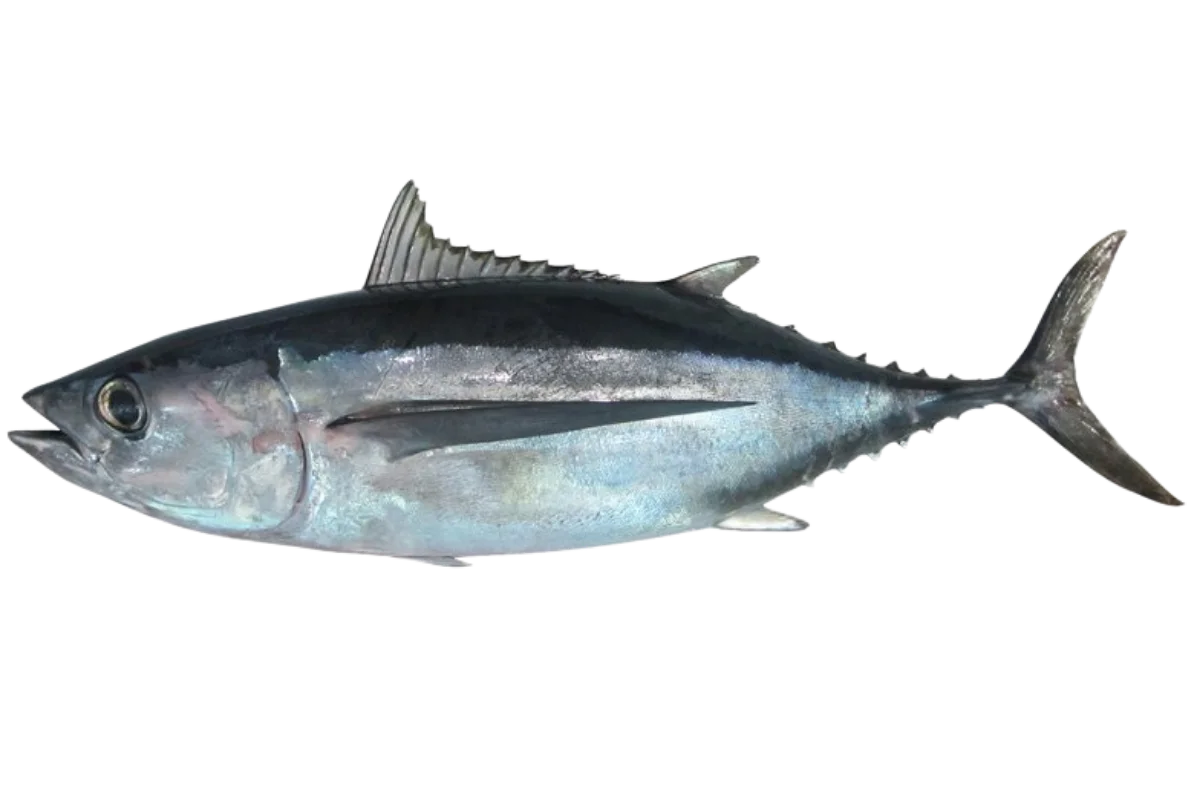
The Albacore is one of the most valuable and elegant pelagic fish crossing the Mediterranean. It is widely known as Alalunga, which derives from its scientific name and means "long wing," while fishers also call it "small tuna." The body is hydrodynamic and torpedo-shaped, with a dark metallic blue colour on the back and silver-white on the belly.
The most defining feature that distinguishes it from all other tuna species involves its pectoral fins. These are unusually long and look like swords or wings that extend backwards, while often reaching beyond the second dorsal fin. Another characteristic that differentiates it is its meat, which is much lighter in colour than that of the Atlantic Bluefin Tuna. It appears almost white or pale pink, which is why it is internationally called White Tuna.
This is a purely pelagic and migratory species that lives in the open sea and rarely approaches the coast. It prefers deep, clear waters, moving over a wide depth range from the surface down to 600 metres in search of food and suitable temperatures. It forms large schools that travel constantly, covering huge distances across the Mediterranean and the Atlantic Ocean.
This is a medium-sized tuna. The common length caught in regional seas ranges from 60 to 100 centimetres with a weight from 5 to 15 kilograms. However, it can reach a maximum length of 1.4 metres and a weight exceeding 60 kilograms, although such sizes are rarer in the Mediterranean than in the ocean.
The animal is a fast and capable hunter that relies on its vision. It feeds mainly on small surface fish that form schools, such as anchovies, sardines, and garfish. It also has a strong preference for cephalopods such as flying squid and common squid, as well as pelagic crustaceans such as shrimp.
Reproduction of the Albacore in the Mediterranean takes place during the summer months. It usually starts in June and lasts until September, with the peak observed in July. The fish gather in specific areas of the Mediterranean, such as around the Balearic Islands and the southern Ionian Sea, to spawn pelagic eggs.
It represents one of the most important commercial catches worldwide. It is caught mainly with surface longlines and trolling by both professionals and recreational fishers. The meat is considered exceptional quality and expensive. This is the only species permitted to be sold as White Tuna in cans, and it is particularly popular for sushi and sashimi due to its delicate flavour.
The International Union for Conservation of Nature classifies the Albacore as a species of Least Concern globally, although Mediterranean populations are monitored closely. Scientific studies have shown that it can regulate its body temperature through regional endothermy, keeping its eyes and brain warmer than the surrounding water. This allows it to hunt effectively in deep and cold depths. Furthermore, genetic research has shown that the Mediterranean population is genetically distinct from the Atlantic population.
| Country | Local Name |
|---|---|
| 🇮🇹 Italy | Alalunga |
| 🇪🇸 Spain | Atún blanco or Bonito del norte |
| 🇫🇷 France | Germon or Thon blanc |
| 🇹🇷 Turkey | Akorkinos or Uzun kanat orkinos |
| 🇲🇹 Malta | Alalonga |
| 🌍 North Africa (Tunisia/Libya/Egypt) | Thon blanc or Alalunga |
| 🌊 Adriatic Coast (Croatia/Slovenia) | Tun dugoper |
| 🇬🇷 Greece | Makrypterygos Tonos or Alalunga or Tonaki |