
Dentex dentex
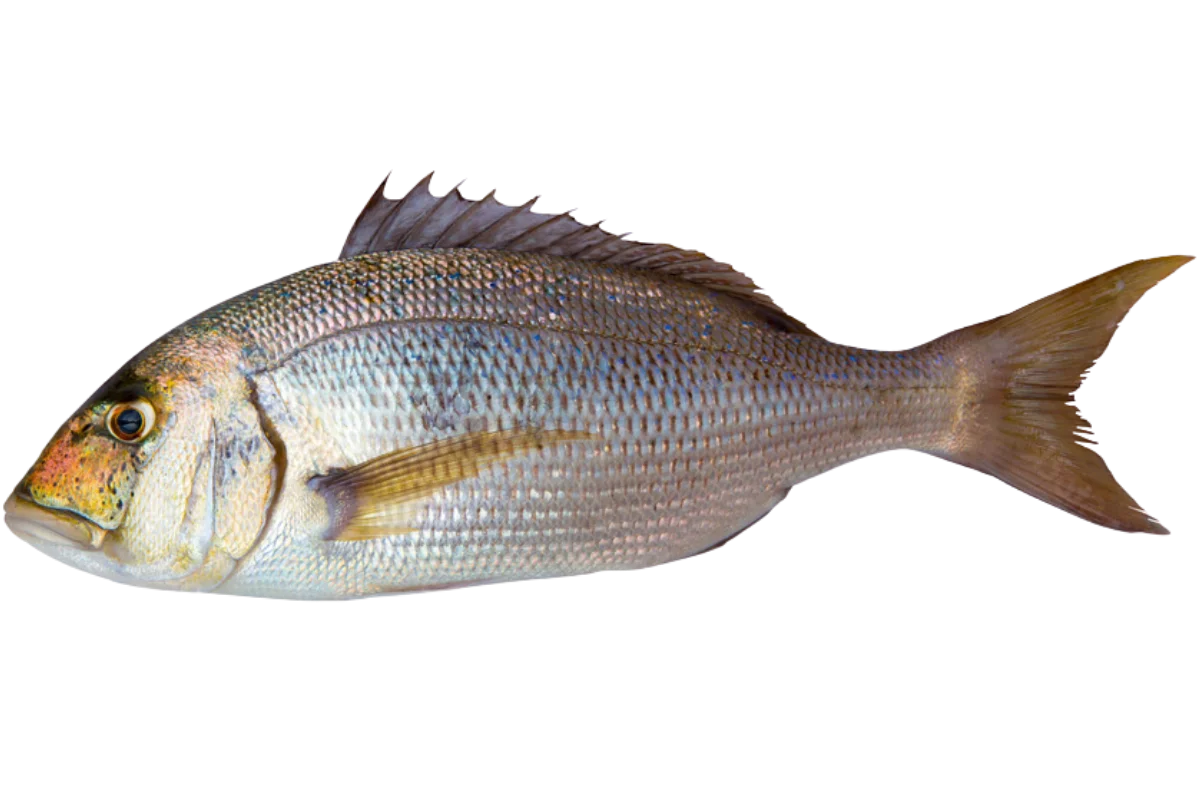
The Common Dentex, which is also widely known as the Dentex or the Queen of the Sea, is the undisputed ruler of the Mediterranean depths and one of the most imposing fish of the Sparidae family. Its scientific name is derived from the Latin word dens, meaning tooth, which perfectly describes its main feature. It possesses a very powerful jaw with four to six large, curved canine teeth in each jaw, which are visible even when its mouth is closed, giving it a fierce, aggressive appearance. In contrast to the Gilthead Seabream, it does not possess molars because it swallows or shreds its prey.
The body is robust, oval, and laterally compressed, with a large and imposing head. Its colour is impressive, featuring a mix of gold and silver with intense pink reflections that darken when the fish is stressed or hunting. When alive, the back and sides are decorated with small iridescent blue and purple spots that resemble precious stones, though these fade quickly after death.
This is a benthopelagic species that lives primarily on rocky bottoms with intense relief, reefs, steep drop-offs, and wrecks, where it finds hiding places and passages for hunting. It is also encountered at the edges of Posidonia seagrass meadows. The depth at which it moves varies with the season: in the summer, it approaches shallow waters at 15 to 50 metres, while in the winter it descends deeper, reaching 200 metres. Young individuals are social and form schools, whereas adult Dentex are solitary, dominant predators that patrol their territory.
The Common Dentex is a large fish. The usual length of capture ranges from 35 to 50 centimetres, and the weight from 1 to 3 kilograms. However, it is a species that can reach a maximum length of one metre and a weight that exceeds 14 to 15 kilograms, even though such trophy sizes are now rare.
The animal is a ruthless, fast, and extremely intelligent predator. It feeds almost exclusively on other fish, such as bogue, damselfish, comber, and sardines, as well as cephalopods. It has a particular weakness for squid and cuttlefish, which it hunts with passion.
Reproduction of the Common Dentex occurs in the spring, usually from March through May or early June, depending on water temperature. In contrast to many other species in its family, such as groupers and the common pandora, the Dentex is primarily gonochoristic. This means that the sexes are separate from birth, and they do not change sex during their lives, although rare cases of hermaphroditism have been reported in young individuals.
It is considered the Holy Grail for recreational fishers due to the great difficulty in its capture. It is suspicious and strong. It is caught with techniques such as bottom trolling with live bait, jigging, and spearfishing. Professionals catch it with thick, long lines and nets. The meat is white and firm with minimal fat and a unique royal flavour, which ranks it among the most expensive and select fish on the market.
The International Union for Conservation of Nature classifies the Common Dentex as a Vulnerable species in the Mediterranean. Scientific studies have shown that it is a species with slow growth and a lifespan of over 20 years. Its populations have decreased significantly due to overfishing, particularly from recreational and illegal fishing during the breeding season, when the fish gather in shallow waters and become vulnerable. Research in marine parks has shown that protecting breeding areas is critical to the species' recovery.
| Country | Local Name |
|---|---|
| 🇮🇹 Italy | Dentice |
| 🇪🇸 Spain | Dentón |
| 🇫🇷 France | Denté commun |
| 🇹🇷 Turkey | Sinarit |
| 🇲🇹 Malta | Dentici |
| 🌍 North Africa (Tunisia/Libya/Egypt) | Denté or Samak al synagrida |
| 🌊 Adriatic Coast (Croatia/Slovenia) | Zubatac |
| 🇬🇷 Greece | Synagrida |