
Cheilopogon heterurus / Parexocoetus mento
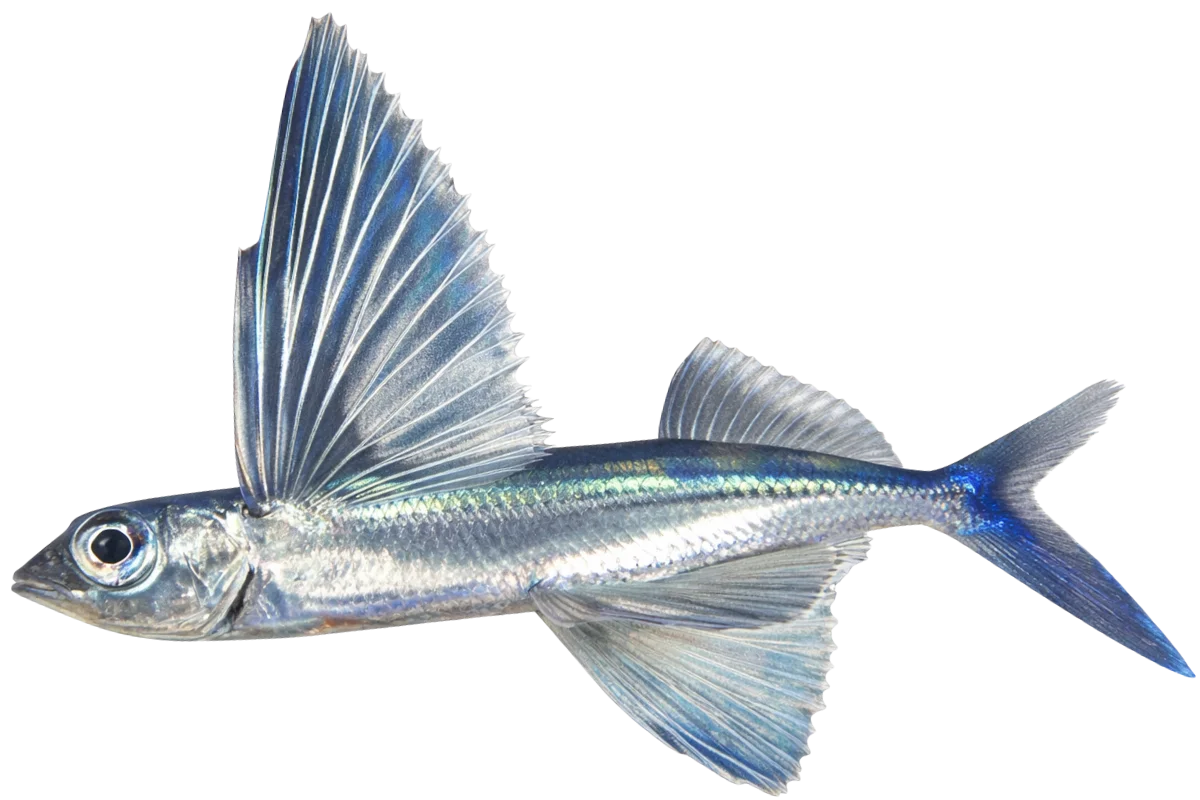
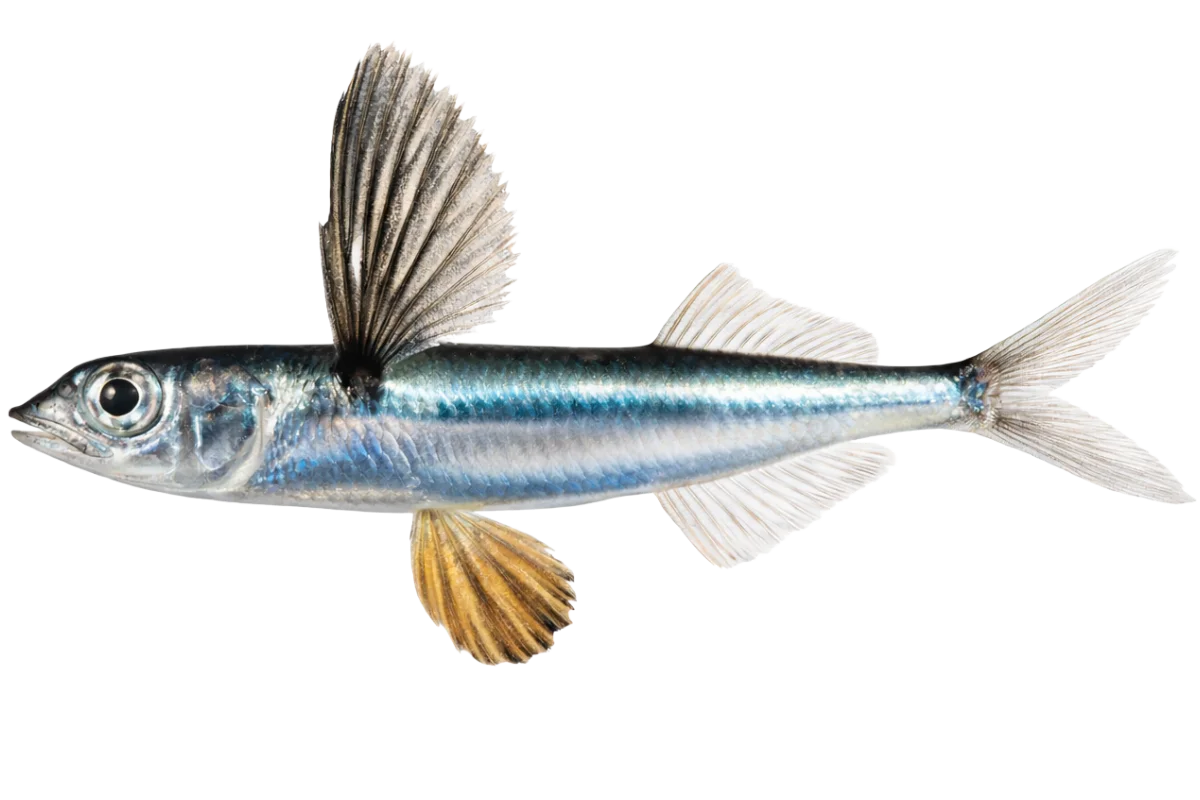
The Flying Fish is a true marvel of natural engineering. It is the only fish capable of emerging from the water and performing actual flights to escape predators while covering breathtaking distances. The body is elongated and silver-blue, resembling a torpedo. The secret of its flight lies in the fins. Its pectoral fins are huge and function exactly like the wings of a glider. Furthermore, the lower lobe of its tail is longer than the upper one and functions like a propeller to provide the necessary thrust before takeoff.
In the Mediterranean, we primarily encounter two species. The Mediterranean Flying Fish is the local species. The African Flying Fish is a Lessepsian migrant that arrived from the Red Sea and has flooded the Eastern Mediterranean. Both are known for their spectacular ability to glide above the waves.
The Flight Technique
To fly, the fish swims at high speed towards the surface. It thrusts its body out but keeps the bottom edge of the tail in the water. It beats its tail at an incredible speed of fifty to seventy times per second to gain thrust and reach speeds exceeding 60 kilometres per hour. Then it opens its wings and takes off while gliding in the air for 50 to 200 metres or even more with a favourable wind.
This is a purely epipelagic species. It lives exclusively in the blue zone of the open sea in the first few metres below the surface, from zero to 20 metres. It rarely approaches the coasts unless the waters are deep. We often see them jumping in front of the bows of ships travelling in the open sea.
It is a small fish. Its usual length ranges from 15 to 30 centimetres, although the Mediterranean species can reach 40 centimetres. The migratory species is generally smaller, reaching 15-20 centimetres.
The animal feeds exclusively on zooplankton and microscopic crustaceans found at the water surface. It represents an important link in the food chain, serving as a primary food source for large pelagic predators such as the common dolphinfish, tuna, and swordfish.
Reproduction takes place in the summer. The eggs of the Flying Fish have a peculiarity because they are sticky and have long filaments. The female lays them on anything that floats in the open sea, such as seaweed, wood, or even rubbish, where they remain attached until they hatch.
There is no targeted fishing for the species in regional waters, but it is caught occasionally in surface nets or trawls. Sometimes it jumps into boats at night if attracted by light. It has moderate commercial value because of its many bones, though the meat is delicious. However, in other countries such as Japan, it is considered a select delicacy, especially its eggs, which are used for Tobiko sushi.
The International Union for Conservation of Nature classifies the common species as Least Concern globally because its populations are stable. Scientific studies have focused on the rapid expansion of Lessepsian species, which have become very abundant in the Eastern Mediterranean and may be competing with local species for food. Furthermore, research into the aerodynamics of their fins has helped in understanding the evolution of flight in animals.
| Country | Local Name |
|---|---|
| 🇮🇹 Italy | Pesce rondine |
| 🇪🇸 Spain | Pez volador |
| 🇫🇷 France | Exocet |
| 🇹🇷 Turkey | Uçan balık |
| 🇲🇹 Malta | Tajra |
| 🌍 North Africa (Tunisia/Libya/Egypt) | Exocet or Samak al chelidonopsaro |
| 🇮🇱 Israel | Flying Fish |
| 🇬🇷 Greece | Chelidonopsaro |