
Dactylopterus volitans
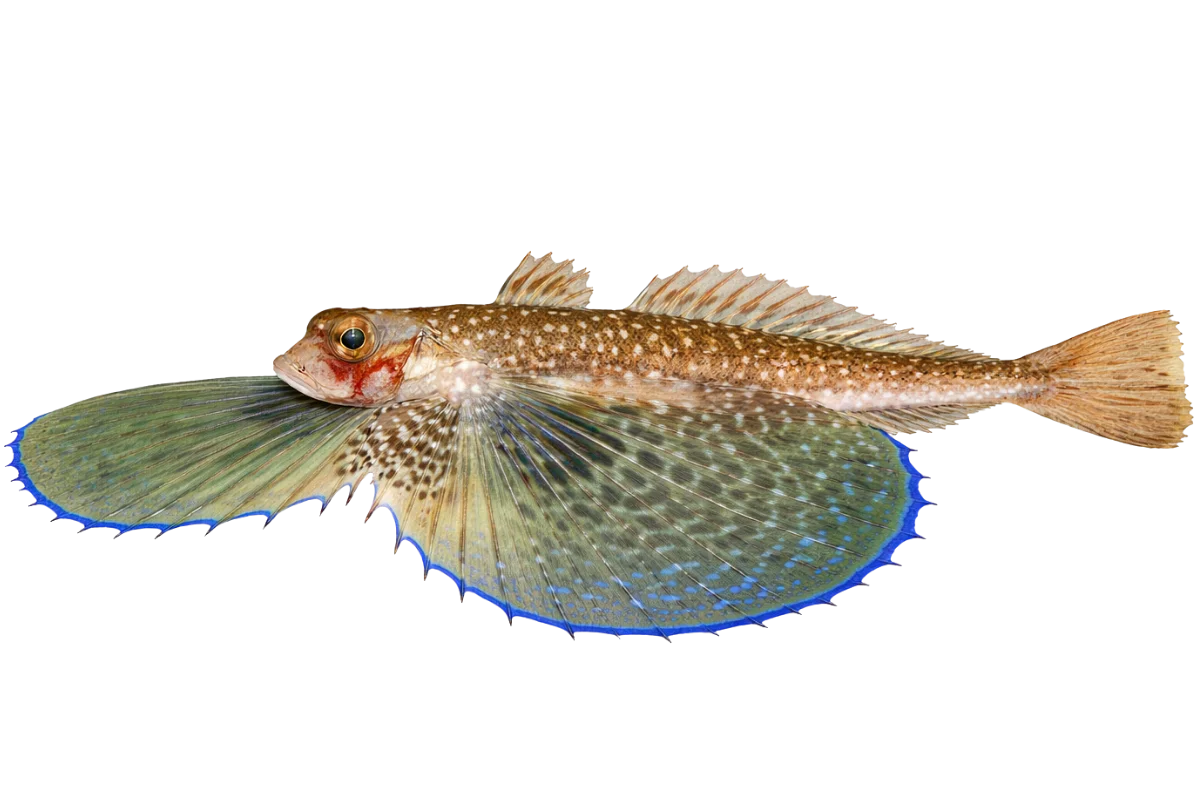
The Flying Gurnard, which is also widely known as the Helmet Gurnard or simply the Swallow Fish, is one of the most impressive and misunderstood fish of the seabed. It belongs to the Dactylopteridae family. Its name is due to the huge pectoral fins that look like the wings of a swallow or a butterfly. Despite its scientific name, which means flying, the Flying Gurnard does not fly out of the water like the True Flying Fish, but instead walks on the seabed.
The body is cylindrical and covered by very hard scales like armour, while its head is square and bony like a helmet. When it feels threatened, it suddenly opens its huge fins, which are decorated with flashy electric-blue spots and lines, to appear much larger and scare the enemy. Furthermore, the first rays of the fins are free, and it uses them like legs to walk on the bottom.
This is an exclusively bottom-dwelling species. It lives on sandy and muddy seabeds, as well as near Posidonia seagrass meadows and rocky areas. It is usually encountered at depths of 1 to 100 metres. It represents a solitary fish that spends its time slowly walking on the floor, searching for food.
The usual length ranges from 20 to 35 centimetres. It can reach a maximum length of 50 centimetres and a weight approaching 2 kilograms, although such sizes are rare.
The animal is a carnivorous fish. It feeds mainly on benthic invertebrates such as crabs, shrimp, and small molluscs that live in the sand. It uses the free parts of its fins to dig into the seabed and flush out its prey.
Reproduction of the Flying Gurnard takes place during the warm summer months, usually from June to August. Its eggs are pelagic.
It is caught mainly as unwanted bycatch by bottom trawls and static nets. Due to its tough skin and bony head, many people find it difficult to clean and discard it. However, the meat is white, delicious, and considered excellent for traditional fish soup because it offers a rich flavour.
The International Union for Conservation of Nature classifies the Flying Gurnard as a species of Least Concern. Scientific studies have shown that it can produce clicking sounds using its jaw and its swim bladder when it feels threatened. Furthermore, research on the mechanics of its movement showed that the way it walks on the seabed is similar to that of four-legged animals.
| Country | Local Name |
|---|---|
| 🇮🇹 Italy | Pesce civetta |
| 🇪🇸 Spain | Pez murciélago or Golondrina |
| 🇫🇷 France | Grondin volant |
| 🇹🇷 Turkey | Uçan kırlangıç balığı |
| 🇲🇹 Malta | Farfett |
| 🌍 North Africa (Tunisia/Libya/Egypt) | Grondin volant or Samak al chelidonas |
| 🌊 Adriatic Coast (Croatia/Slovenia) | Kokotić letač |
| 🇬🇷 Greece | Chelidonas |