
Scomber scombrus
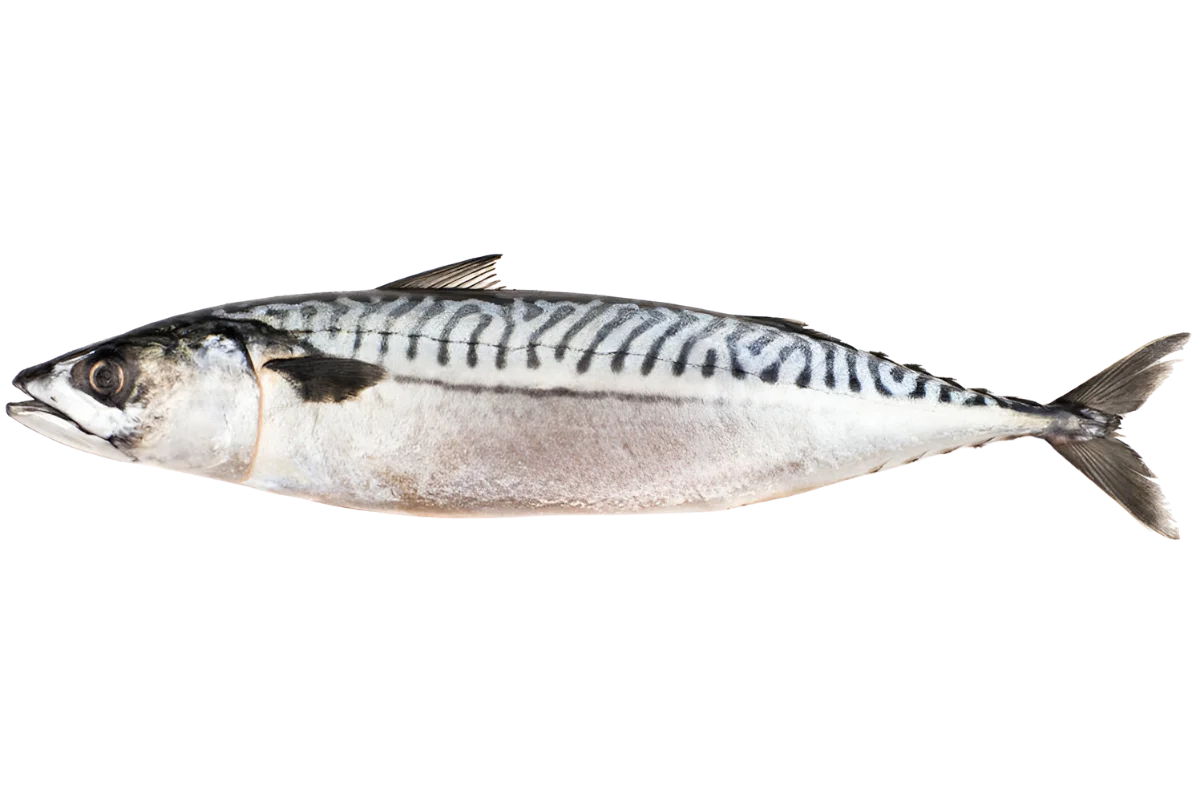
The Atlantic Mackerel, which is also widely known as the Mackerel, is one of the most famous, fast, and nutritious fish of the regional seas. It is a pelagic fish belonging to the Scombridae family, known for its beautiful pattern on its back and its rich flavour. The body is spindle-shaped and extremely hydrodynamic, designed for fast, nonstop swimming. Its back has an intense metallic blue-green colour with characteristic wavy dark vertical stripes like a tiger, which are much clearer and more intense than those of the Chub Mackerel.
The defining element of its physiology is that it lacks a swim bladder. This means that, unlike most fish and the Chub Mackerel, which can hover in the water, the Atlantic Mackerel must swim nonstop throughout its life to avoid sinking and to maintain oxygenation through ram ventilation.
It is often confused with the Chub Mackerel, but a clear distinction exists. The Atlantic Mackerel always has a clear silver-white belly without any marks, spots, or lines, while the belly of the Chub Mackerel has greyish spots or patterns. Furthermore, the eye of the Atlantic Mackerel is noticeably smaller in relation to its head.
This is a purely pelagic and cold-water species that lives in the open sea. It has no permanent home because the school travels constantly, making extensive migrations. In the spring and summer, the schools approach the coasts and rise to the surface to feed and reproduce, while in the winter, they withdraw to deeper waters of up to 250 metres, and their activity decreases significantly.
This is a purely pelagic and cold-water species that lives in the open sea. It has no permanent home because the school travels constantly, making extensive migrations. In the spring and summer, the schools approach the coasts and rise to the surface to feed and reproduce, while in the winter, they withdraw to deeper waters of up to 250 metres, and their activity decreases significantly.
The animal is both an active hunter and a filter feeder. It feeds mainly on zooplankton such as copepods and small shrimp, which it filters while swimming with an open mouth, along with small fish like anchovies, silversides, and sardines, which it hunts actively in schools.
The animal is both an active hunter and a filter feeder. It feeds mainly on zooplankton such as copepods and small shrimp, which it filters while swimming with an open mouth, along with small fish like anchovies, silversides, and sardines, which it hunts actively in schools.
It is caught in bulk by professionals using purse seines and trawlers, and targeted by recreational fishers using multi-hook rigs and surface trolling. It has great commercial and nutritional value because it is one of the richest fish in Omega-3 fatty acids and vitamins. The meat is extremely delicious with an intense flavour. It is eaten grilled, often paired with tomato and onion, or smoked or salted. When salted and dried in the sun, it is called tsiros, a classic local delicacy.
The International Union for Conservation of Nature classifies the Atlantic Mackerel as a species of Least Concern. However, scientific studies have shown that its populations in the Mediterranean are genetically differentiated from those in the Atlantic, which indicates that the Mediterranean functions as a separate region for the species. Research also showed that the lack of a swim bladder gives it the advantage of being able to change depth instantly because it does not need to balance gas pressure. This makes it extremely flexible in hunting and escape.
| Country | Local Name |
|---|---|
| 🇮🇹 Italy | Sgombro |
| 🇪🇸 Spain | Caballa |
| 🇫🇷 France | Maquereau |
| 🇹🇷 Turkey | Uskumru |
| 🇲🇹 Malta | Kavalli |
| 🌍 North Africa (Tunisia/Libya/Egypt) | Maquereau or Samak al skoumbri |
| 🌊 Adriatic Coast (Croatia/Slovenia) | Skuša |
| 🇬🇷 Greece | Skoumbri or Tsiros |