
Sepia officinalis
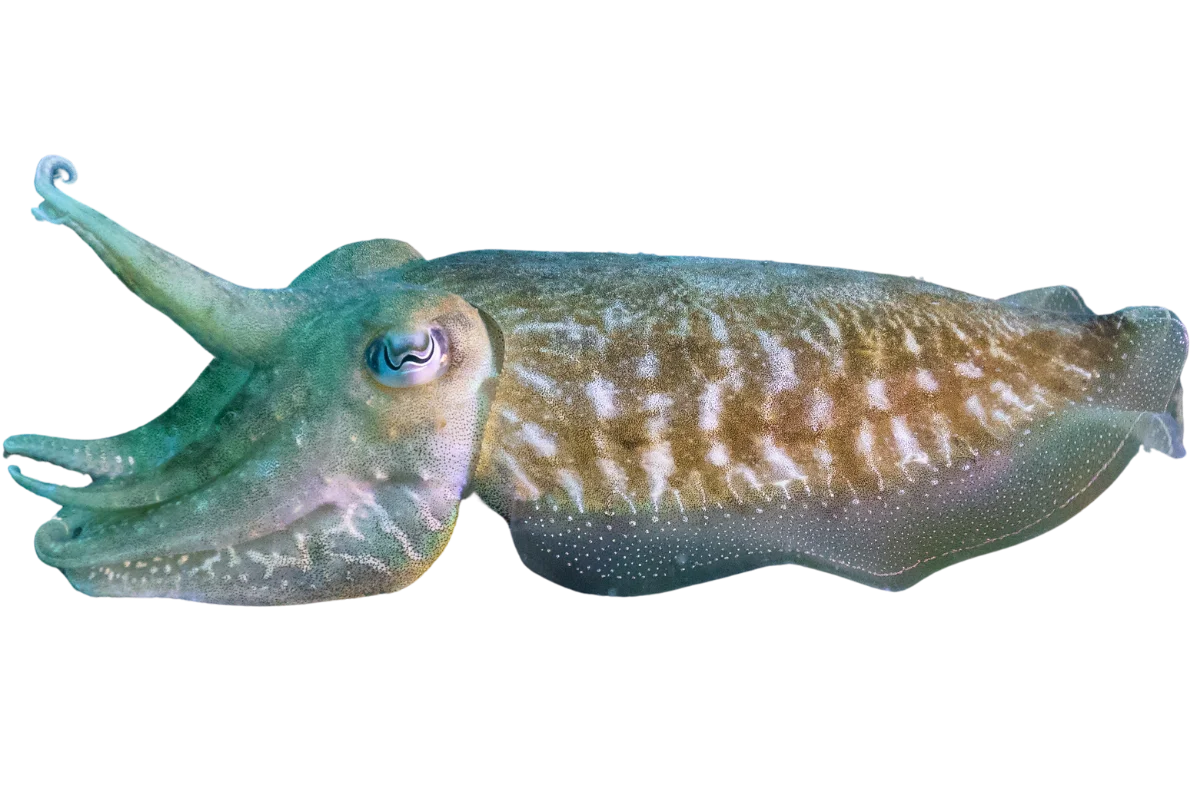
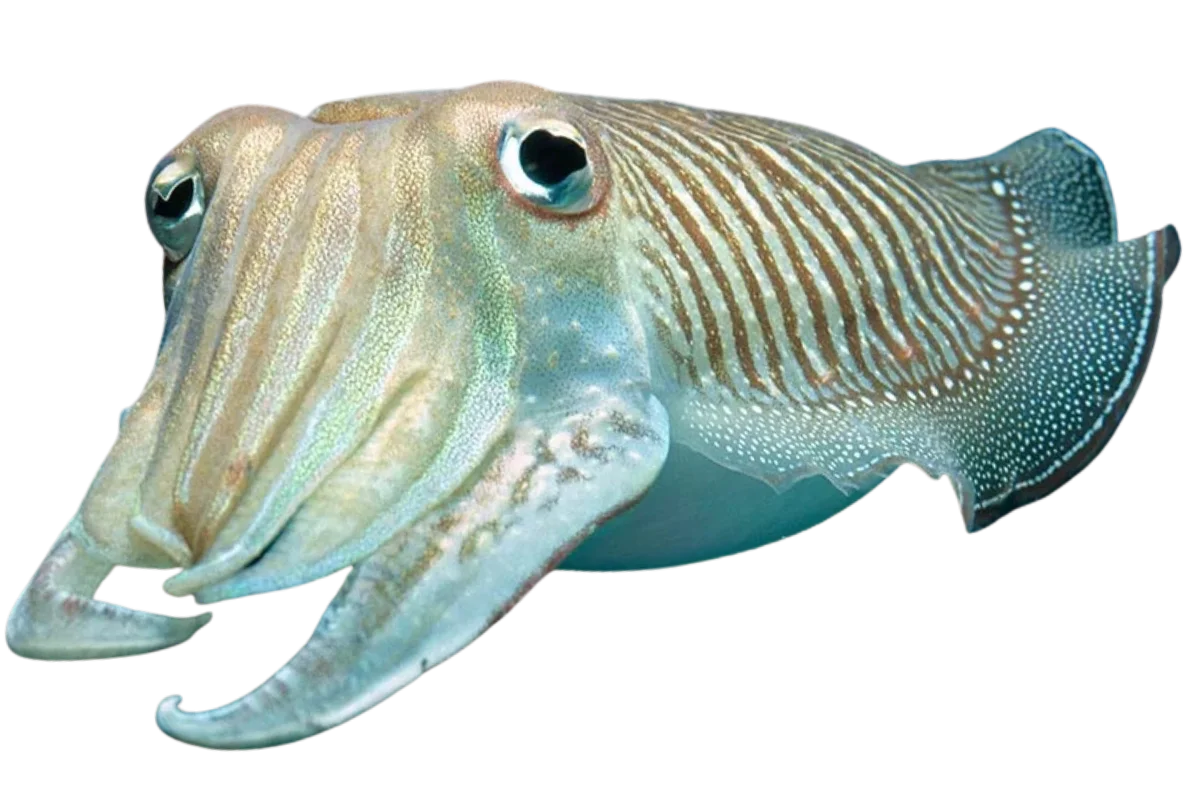
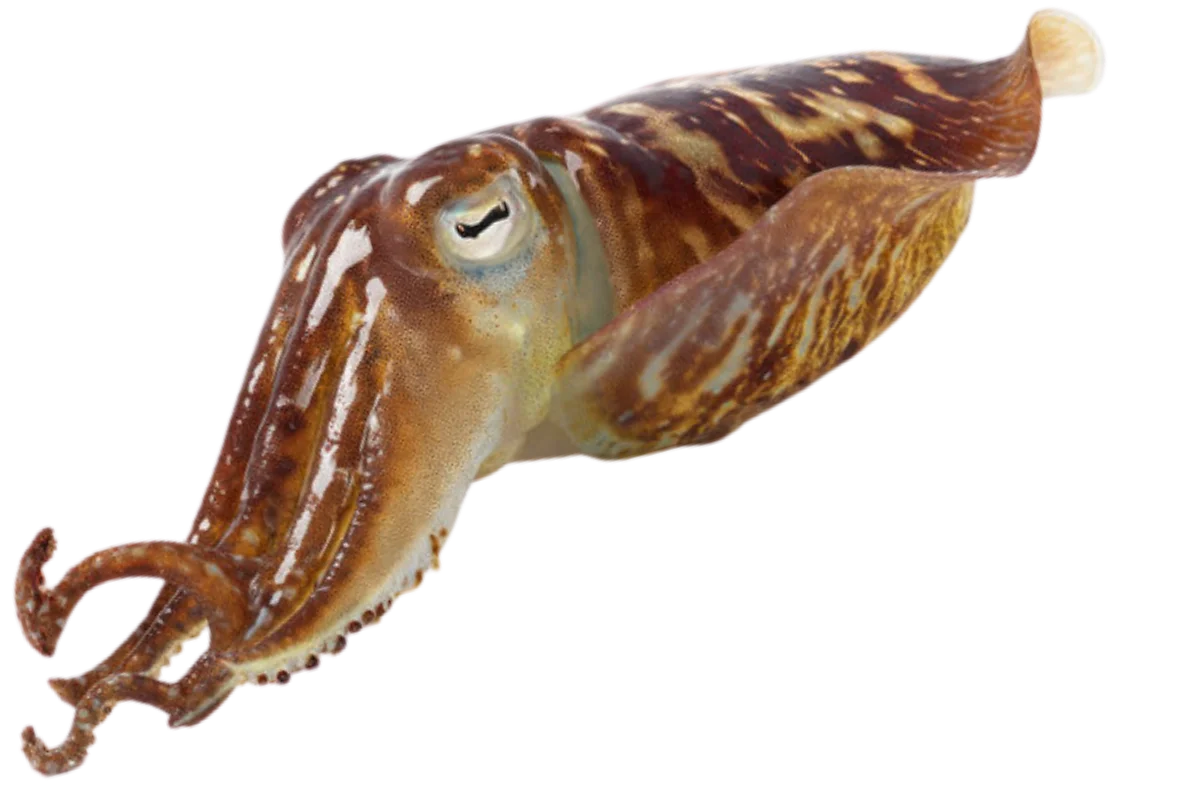
The Common Cuttlefish is one of the most intelligent and sophisticated invertebrates of the regional seas and belongs to the class of Cephalopods. The body is wide and oval, surrounded by a single fin that runs around the perimeter of its trunk like a skirt, allowing it to move with grace. It possesses eight smaller tentacles and two much longer hunting tentacles, which it launches instantly to grab its prey and which it keeps hidden in special pouches when not hunting.
The most famous feature is its internal shell, the well-known cuttlebone. This is not simply a skeleton but a marvel of physical engineering, full of microscopic gas chambers that allow it to regulate its buoyancy with the precision of a submarine by filling or emptying the chambers with liquid. Furthermore, it is famous for its ability to change skin colour and texture in fractions of a second, thanks to the chromatophore cells it possesses.
It represents a species that lives mainly in coastal waters and prefers sandy or muddy bottoms, as well as Posidonia meadows, where it can camouflage itself perfectly by mimicking the environment. It is encountered at depths ranging from 2 metres to 200 metres. During the winter, it withdraws to deeper waters, while in the spring, it approaches the coasts in large numbers to reproduce.
The usual length of the mantle ranges from 15 to 25 centimetres. However, it is a species that can reach a maximum length of 35 to 40 centimetres and a weight that exceeds 2 kilograms. Very large individuals are often called barrels by local fishers.
The animal is a formidable ambush predator that relies on camouflage. It feeds mainly on crustaceans such as crabs and shrimp, as well as small fish. When it feels threatened, it ejects a dense cloud of brown and black ink that contains substances that numb predators' sense of smell, giving it time to escape.
Reproduction occurs in winter and spring. Females lay eggs that have a black colour and look like bunches of grapes, which they hang on hard objects, ropes, or plants. The mating behaviour of the cuttlefish is extremely complex. When a smaller male wants to mate with a female, but a dominant male is nearby, it uses an incredible trick. On the side facing the female, it displays courtship colours, while on the side facing the competitor, it mimics the female's colours to deceive him into thinking he sees two females.
Reproduction occurs in winter and spring. Females lay eggs that have a black colour and look like bunches of grapes, which they hang on hard objects, ropes, or plants. The mating behaviour of the cuttlefish is extremely complex. When a smaller male wants to mate with a female, but a dominant male is nearby, it uses an incredible trick. On the side facing the female, it displays courtship colours, while on the side facing the competitor, it mimics the female's colours to deceive him into thinking he sees two females.
The International Union for Conservation of Nature classifies the Common Cuttlefish as a species of Least Concern. Scientific studies have shown that it possesses one of the highest levels of intelligence in the animal kingdom, comparable to that of primates. Experiments showed that it can pass the marshmallow test, demonstrating self-control by waiting to receive better-quality food later and indicating advanced cognitive abilities and the capacity for future planning.
| Country | Local Name |
|---|---|
| 🇮🇹 Italy | Seppia comune |
| 🇪🇸 Spain | Sepia or Jibia |
| 🇫🇷 France | Seiche commune |
| 🇹🇷 Turkey | Sübye |
| 🇲🇹 Malta | Sicċa |
| 🌍 North Africa (Tunisia/Libya/Egypt) | Seiche or Samak al soupia |
| 🌊 Adriatic Coast (Croatia/Slovenia) | Sipa |
| 🇬🇷 Greece | Soupia |