
Fistularia commersonii
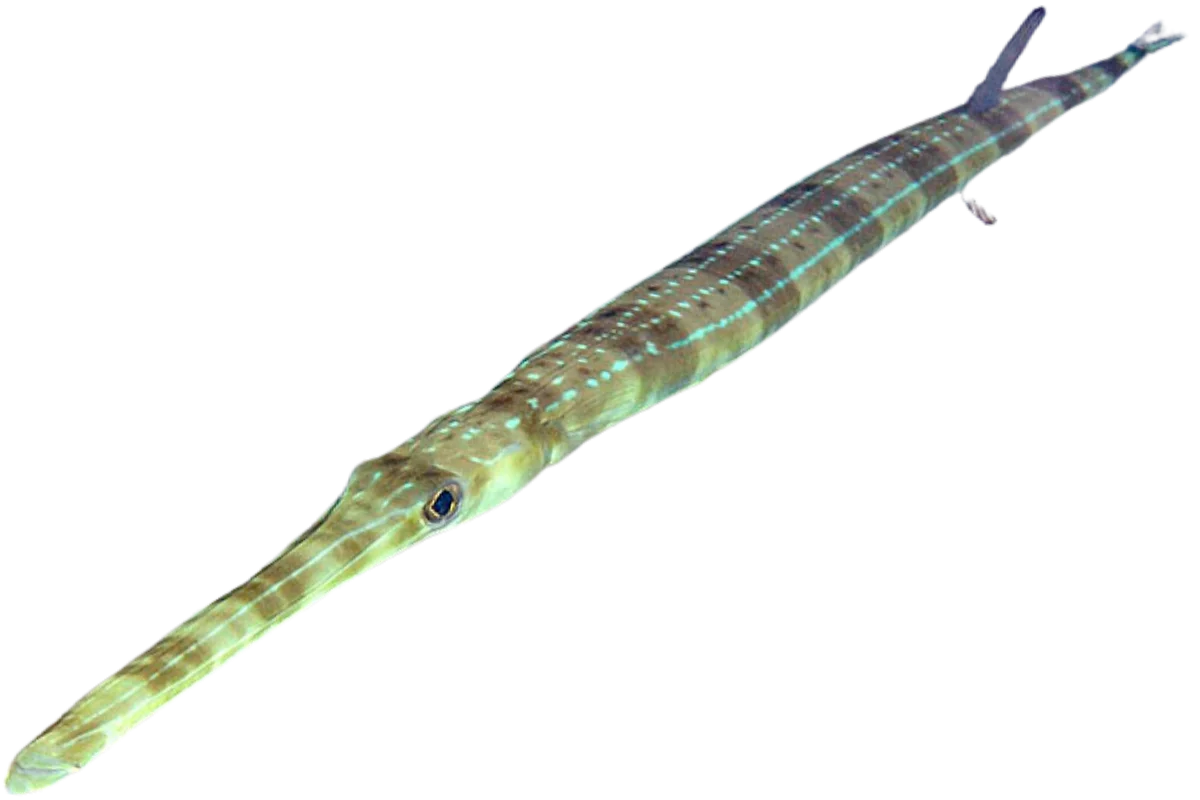
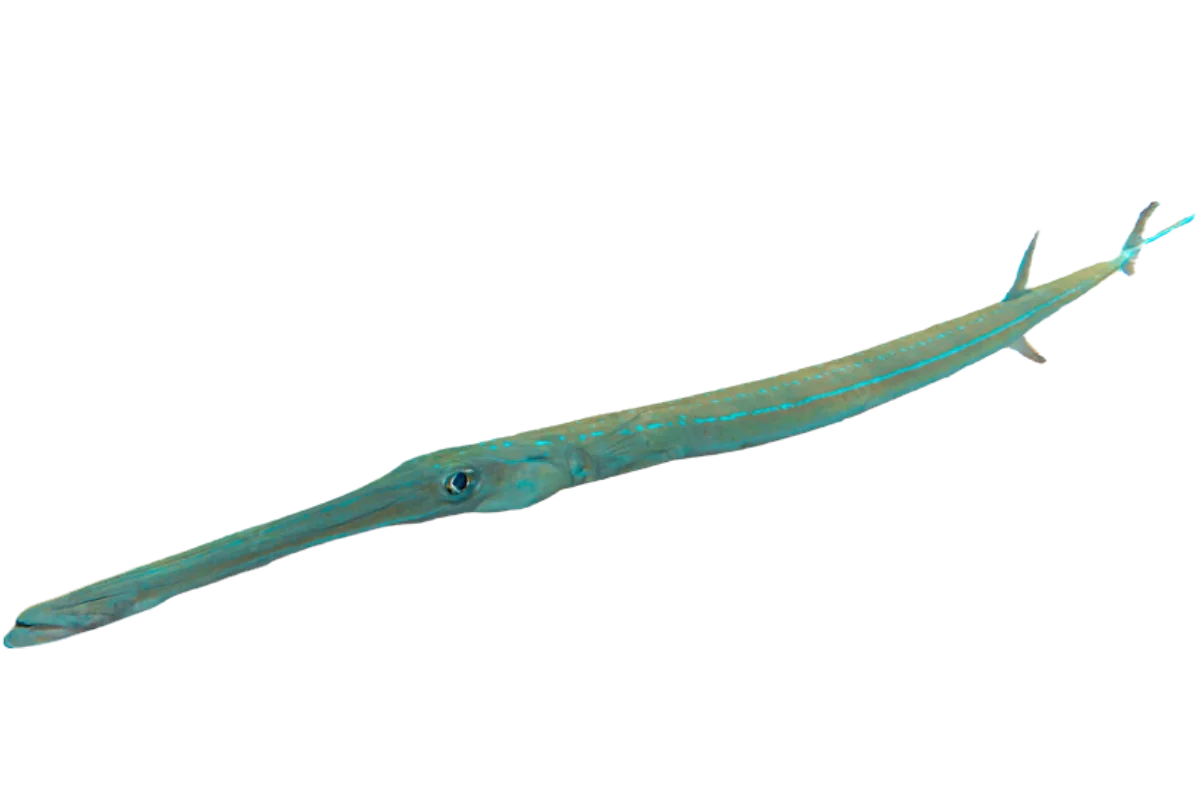
The Bluespotted Cornetfish, also widely known as the Cornetfish, Smooth Flutemouth, or Trumpetfish, is arguably the most successful and rapidly expanding Lessepsian migrant in the Mediterranean. It is a long, extremely thin fish with an unusual shape resembling a tube or a musical instrument. The colour is olive green on the back and greyish on the belly. When alive, the body is decorated with two characteristic, intensely blue, iridescent lines or rows of spots running along its back.
Aside from its endless snout, the most characteristic feature is its tail. It has a forked tail from the centre of which starts a very long and thin filament, like a whip or antenna, which acts as a sensory organ and can reach a length equal to half the body of the fish.
This species, originating in the Indian and Pacific Oceans, invaded the Mediterranean through the Suez Canal. It has adapted perfectly to the warm waters of the basin. It lives in shallow coastal waters, usually over sandy bottoms and Posidonia meadows, but also near rocks. The depth at which it is encountered ranges from the surface down to 100 metres. It often forms large and loose schools that patrol just below the surface or near the bottom.
The Bluespotted Cornetfish is a very long fish. It can reach a maximum length of 1.5 metres, excluding the tail filament, although the individuals usually encountered are around 1 metre long.
Although it appears innocent and fragile, the fish is a ruthless and extremely effective predator that has been characterised as a fry killer. Its long tubular snout works like a powerful pipette or pump. It approaches schools of small fish slowly and silently. Once it reaches firing range, it opens its mouth suddenly, creating a vacuum that sucks in the prey. It feeds almost exclusively on fish and secondarily on squid and shrimp.
The biology of its reproduction in the Mediterranean is still being studied, as it is a new species. It appears to reproduce during the warm months of the year. The speed with which it flooded the Mediterranean from Israel to Spain within a few years indicates that it has extremely high reproductive success and that its eggs or larvae travel easily with the currents.
It is very often caught as unwanted bycatch in set nets, bottom trawls, and purse seines. It is also easily caught with rods or surface trolling because it attacks artificial lures. In regional markets, it has very little or no commercial value. Most people do not know the fish and fear its strange appearance, and find it difficult to clean because of its shape and bones. However, the meat is white and firm, with few bones, and quite tasty, resembling sole or cod in texture. In other countries, such as Japan, it is considered a choice delicacy for sashimi or soup.
The International Union for Conservation of Nature has not yet fully assessed its impact on the Mediterranean. However, scientific studies sound the alarm. It has been found that the Bluespotted Cornetfish has an extremely fast metabolism and consumes large quantities of the fry of commercially fished species such as red mullets and bogues, thereby threatening the renewal of their populations. Furthermore, the absence of natural enemies in the Mediterranean allows it to multiply uncontrollably.
| Country | Local Name |
|---|---|
| 🇮🇹 Italy | Pesce trombetta |
| 🇪🇸 Spain | Corneta |
| 🇫🇷 France | Poisson cornet |
| 🇹🇷 Turkey | Çutlin balığı |
| 🇲🇹 Malta | Trumbetta |
| 🌍 North Africa (Tunisia/Libya/Egypt) | Poisson trompette or Samak al trompeta |
| 🇨🇾 Cyprus | Pithkiauli |
| 🇬🇷 Greece | Trompeta or Fistularia or Korneta |