
Symphodus tinca / Labrus viridis / Labrus merula
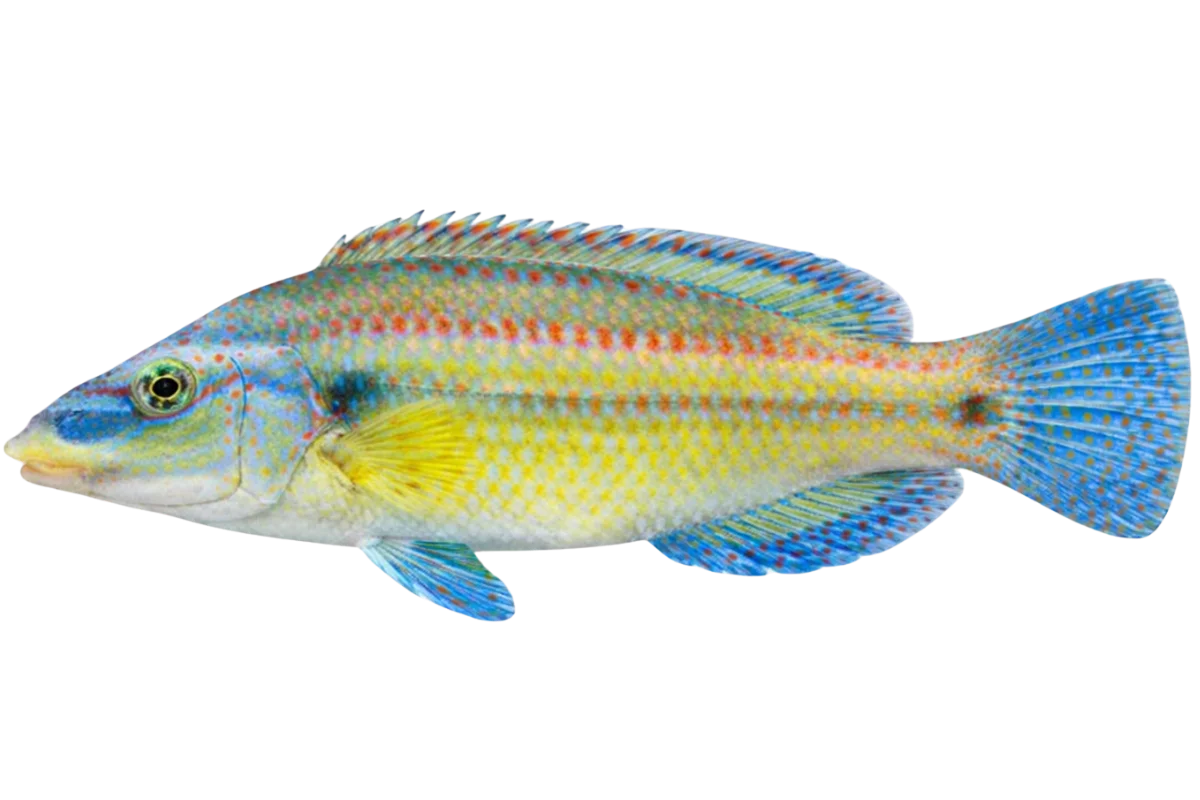
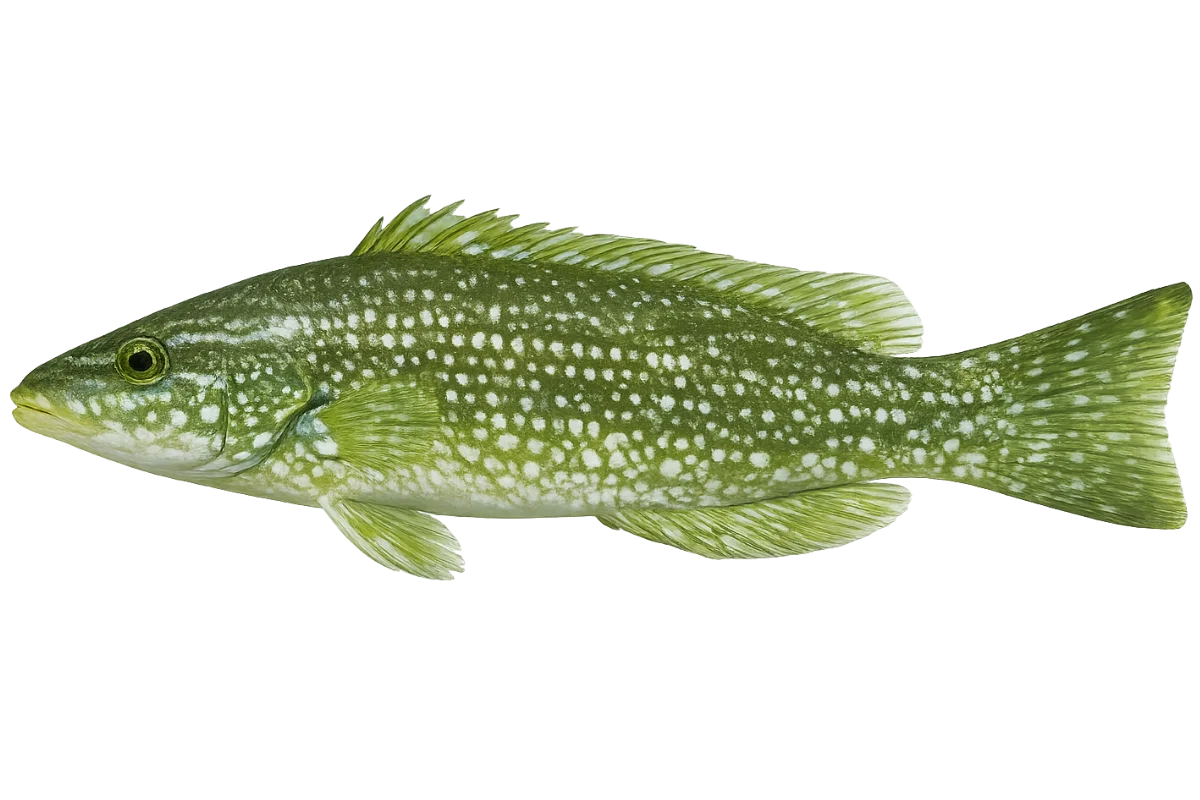
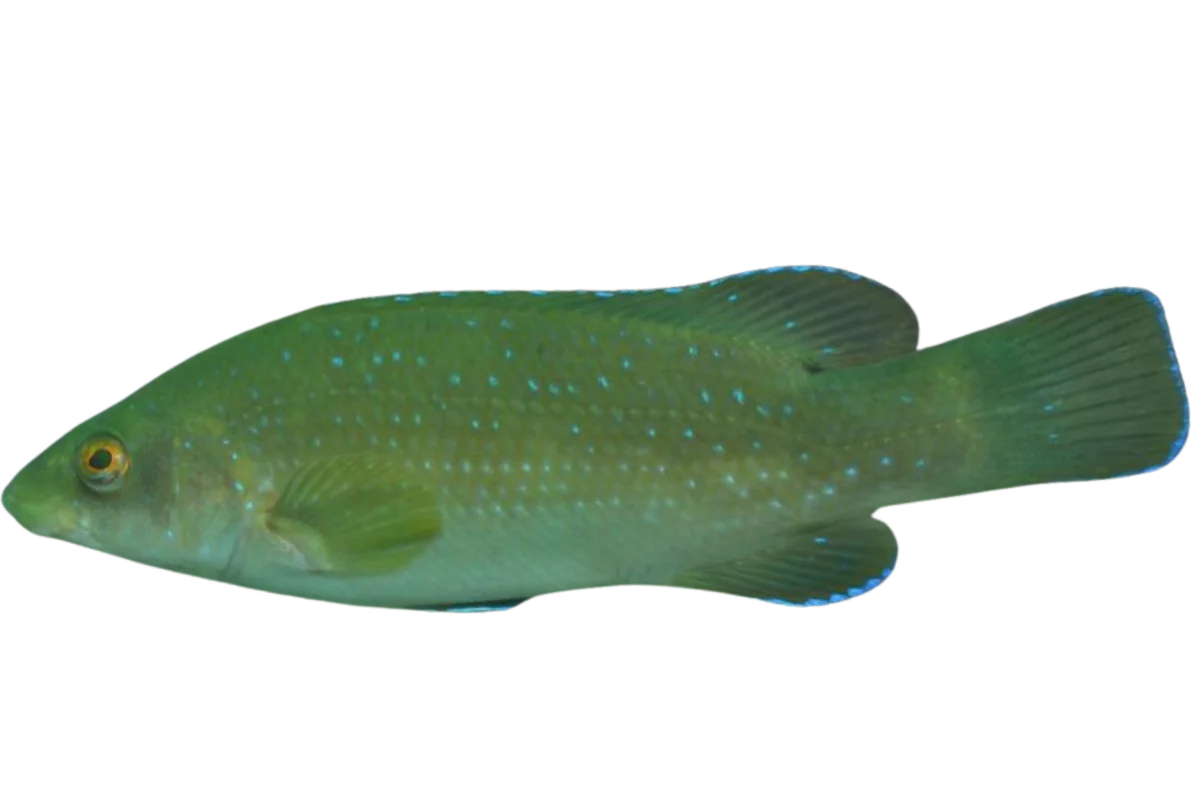
The Wrasse, which is also widely known as the Peacock Wrasse, the Green Wrasse, or the Brown Wrasse, is one of the most colourful and common fish of the regional seas. It belongs to the large family of Labridae, which also includes the rainbow wrasse and the parrotfish. Its name is derived from its fleshy and large lips, which represent its most characteristic feature. The body is oval and covered with large cycloid scales.
There is a wide variety of species and colours, with the most common being as follows. The Peacock Wrasse is the most common species; males have a flamboyant yellow-green colour with red and blue spots, while females are greyish. The Green Wrasse has an elongated body and an intense emerald-green colour with white spots, which allows it to blend into the seaweed. The Brown Wrasse has a dark brown or black colour and lives in deeper rocky spots. All these fish exhibit strong sexual dimorphism. The males are true works of art, with iridescent colours and complex patterns on their heads, while the females have camouflage colours in brown or olive to hide among the rocks.
This is a purely coastal benthic species. It lives in shallow waters, usually between 1 and 50 metres deep. It loves rich seabeds, including areas with dense vegetation and Posidonia seagrass meadows, as well as rocky bottoms with stones and crevices. It is a diurnal fish. At night, it exhibits a unique behaviour, sleeping deeply while lying on its side among the rocks or wrapped in seaweed.
The size varies depending on the species. The Peacock Wrasse usually reaches 20 to 25 centimetres and a maximum of 40 centimetres. The Green Wrasse and the Brown Wrasse are larger and can reach a length of 45 to 50 centimetres and a weight of up to 1 kilogram.
The size varies depending on the species. The Peacock Wrasse usually reaches 20 to 25 centimetres and a maximum of 40 centimetres. The Green Wrasse and the Brown Wrasse are larger and can reach a length of 45 to 50 centimetres and a weight of up to 1 kilogram.
Reproduction of the Wrasse is impressive and occurs in the spring, from March to June. Most species are protogynous hermaphrodites, meaning they are born female and become male. The male Peacock Wrasse builds an elaborate nest from seaweed, which it carries with its mouth and sticks together with a special mucus. Then it performs an impressive dance to attract females to lay eggs in the nest. After fertilising the eggs, the male remains there and aggressively guards them until they hatch.
Reproduction of the Wrasse is impressive and occurs in the spring, from March to June. Most species are protogynous hermaphrodites, meaning they are born female and become male. The male Peacock Wrasse builds an elaborate nest from seaweed, which it carries with its mouth and sticks together with a special mucus. Then it performs an impressive dance to attract females to lay eggs in the nest. After fertilising the eggs, the male remains there and aggressively guards them until they hatch.
The International Union for Conservation of Nature classifies most species of Wrasse as Least Concern, although the Green Wrasse is considered Vulnerable due to the destruction of Posidonia meadows. Scientific studies have discovered the existence of sneaker males or satellite males. These are small males that have the colour of females, so that the dominant male does not attack them. They enter the nest secretly at the time of mating and fertilise the eggs while stealing paternity.
| Country | Local Name |
|---|---|
| 🇮🇹 Italy | Tordo pavone or Tordo verde or Tordo nero |
| 🇪🇸 Spain | Tordo or Merlo or Pintano |
| 🇫🇷 France | Vieille or Labre vert or Roucaou |
| 🇹🇷 Turkey | Çırçır balığı |
| 🇲🇹 Malta | Lena or Membru |
| 🌍 North Africa (Tunisia/Libya/Egypt) | Vieille or Samak al heilou |
| 🌊 Adriatic Coast (Croatia/Slovenia) | Hinja or Vrana or Drozd |
| 🇬🇷 Greece | Cheilou or Lampina |