
Octopus vulgaris
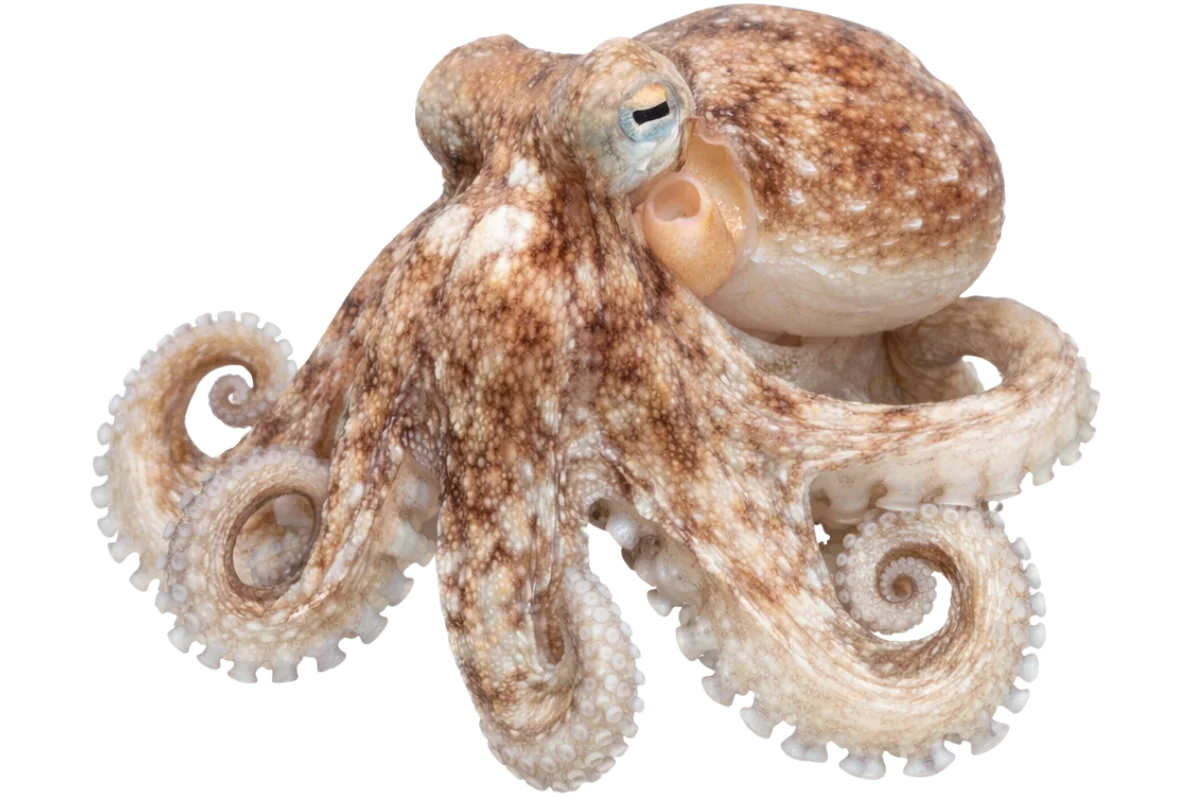
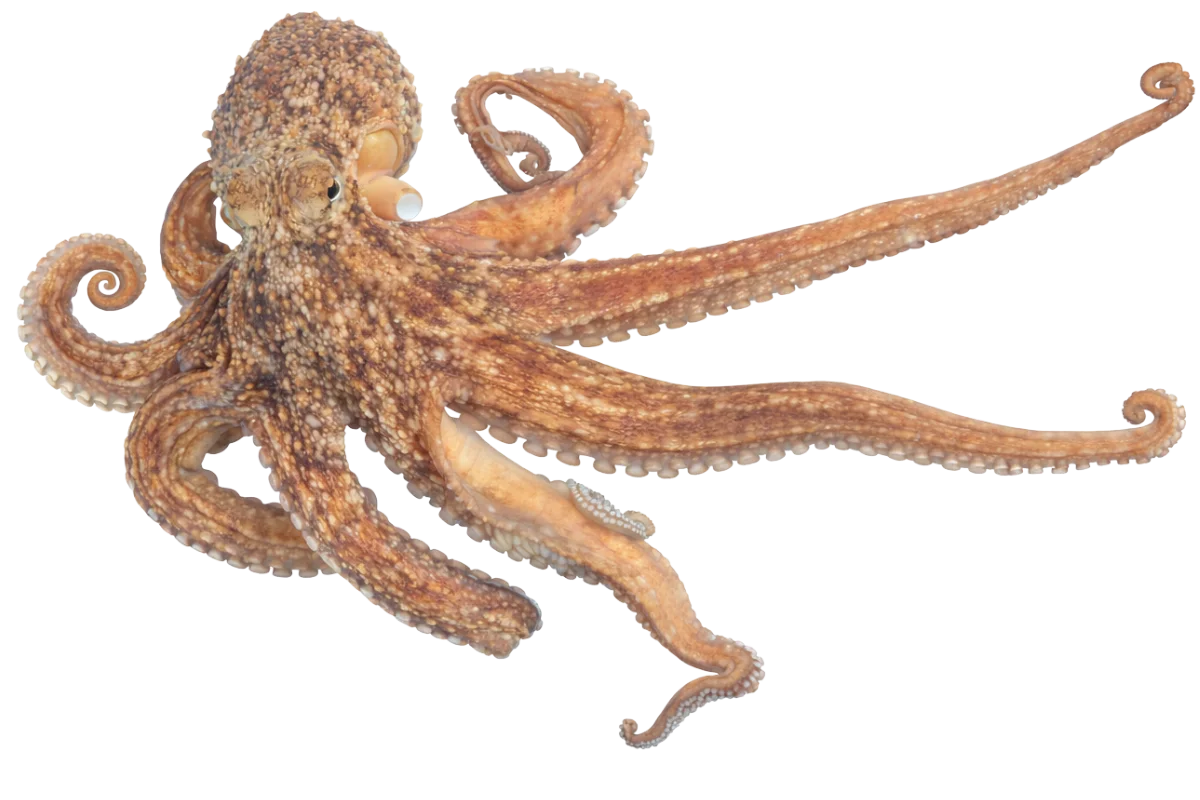
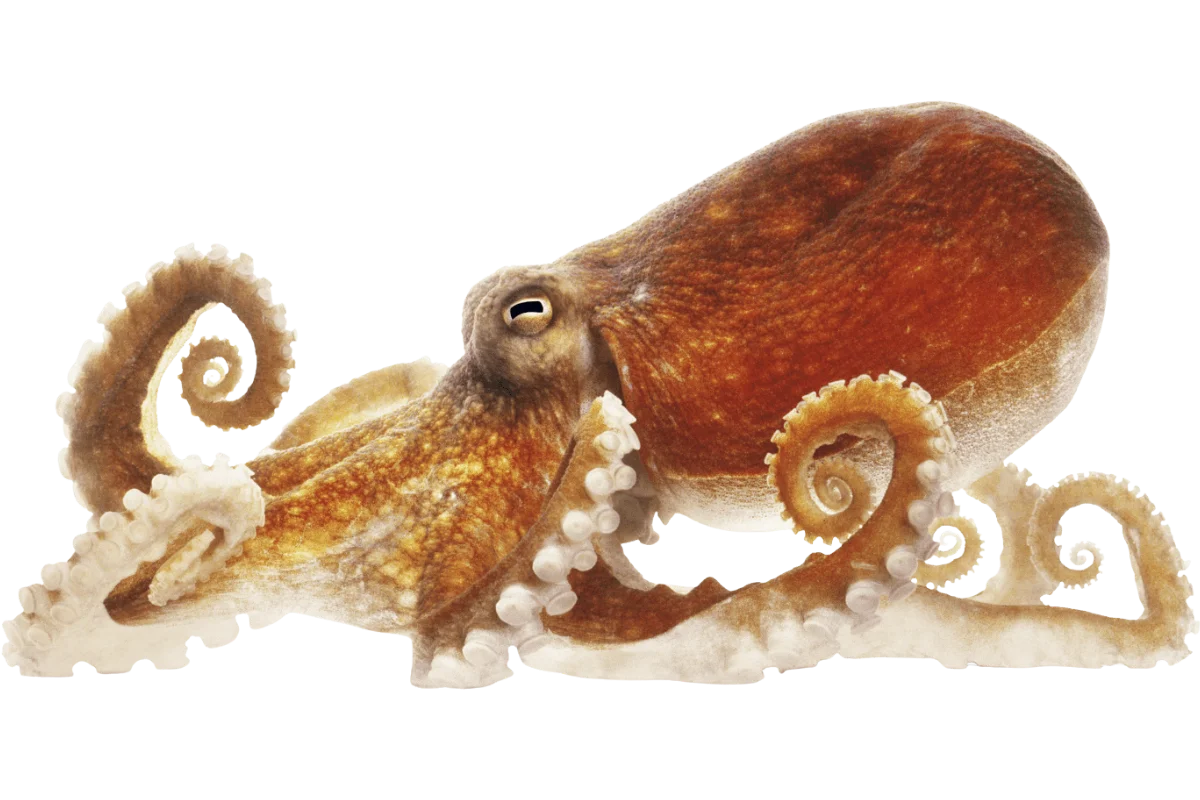
The Common Octopus is the undisputed king of the Cephalopods and, without a doubt, the most intelligent invertebrate on the planet. It is famous for its eight arms, its ability to change colour and shape in fractions of a second, and its unique deliciousness. In contrast to the squid and the cuttlefish, which have ten tentacles consisting of eight arms and two hunting tentacles, the octopus has only eight arms, which are full of two rows of suckers.
The anatomy of the octopus is unique and resembles an alien creature. It possesses three hearts: one main heart that supplies blood to the body, and two smaller branchial hearts that supply blood to the gills. Its blood is not red but blue because it relies on copper rather than iron for oxygen transport. Furthermore, it possesses a complex nervous system with a central brain and smaller nerve centres at the base of each arm, allowing the arms to function semi-autonomously and to think and react on their own.
It represents the absolute master of camouflage. Its skin is full of millions of special chromatophore cells, which it controls with its nervous system. It can change colour, pattern, or even texture, producing lumps and spines in fractions of a second, becoming one with the rock, the sand, or the seaweed.
The animal lives mainly on rocky bottoms full of holes and dens where it makes its nest. It is known for its habit of tidying up its home by collecting stones and shells to seal the den entrance for protection. It lives from very shallow waters, a few centimetres deep, to depths of 100 to 200 metres. It is a solitary and territorial animal.
This is the largest octopus species in the Mediterranean. It can reach a length of 1 to 1.5 metres, including the arms, and a weight of up to 10 kilograms, although common individuals are 1 to 3 kilograms.
At night, it comes out to hunt. It feeds mainly on crabs, which are its favourite food, along with molluscs and fish. The hard crabs possess a very hard black beak at the centre of their arms that resembles the beak of a parrot, while they use this to break shells and inject paralysing saliva.
Reproduction marks the end of the life of the octopus. The male fertilises the female using a specialised arm and dies a short time later. The female withdraws to her den and lays thousands of eggs, which she hangs from the ceiling like curtains. For the next few months, the mother eats nothing. She stays there to clean and aerate the eggs to prevent fungi. Once the eggs hatch, the exhausted mother dies of starvation.
It has enormous commercial and gastronomic value. It is caught in many ways, including spearfishing while searching the den, octopus jigs, pots and jars, or harpoons in the shallows.
Fresh octopus is tough. To soften it, the animal must be beaten hard on the rocks, traditionally forty times, and rubbed until the fibres break and the tentacles curl. It is considered the king of appetisers, especially when sun-dried and grilled over charcoal, though it also makes an excellent stew or a vinegar-based dish.
The International Union for Conservation of Nature classifies the Common Octopus as a species of Least Concern. Scientific studies have shown that the octopus has intelligence approaching that of dogs. It is capable of solving problems such as unscrewing jars to get food, using tools like coconut shells for protection, and recognising human faces. Furthermore, it has been observed that it has a personality in which some individuals are shy, and others are bold.
| Country | Local Name |
|---|---|
| 🇮🇹 Italy | Polpo comune |
| 🇪🇸 Spain | Pulpo común |
| 🇫🇷 France | Poulpe commun |
| 🇹🇷 Turkey | Bayağı ahtapot |
| 🇲🇹 Malta | Qarnita |
| 🇬🇷 Greece | Chtapodi |
| 🌍 North Africa (Tunisia/Libya/Egypt) | Akhtabout |
| 🌊 Adriatic Coast (Croatia/Slovenia) | Hobotnica |