
Micromesistius poutassou
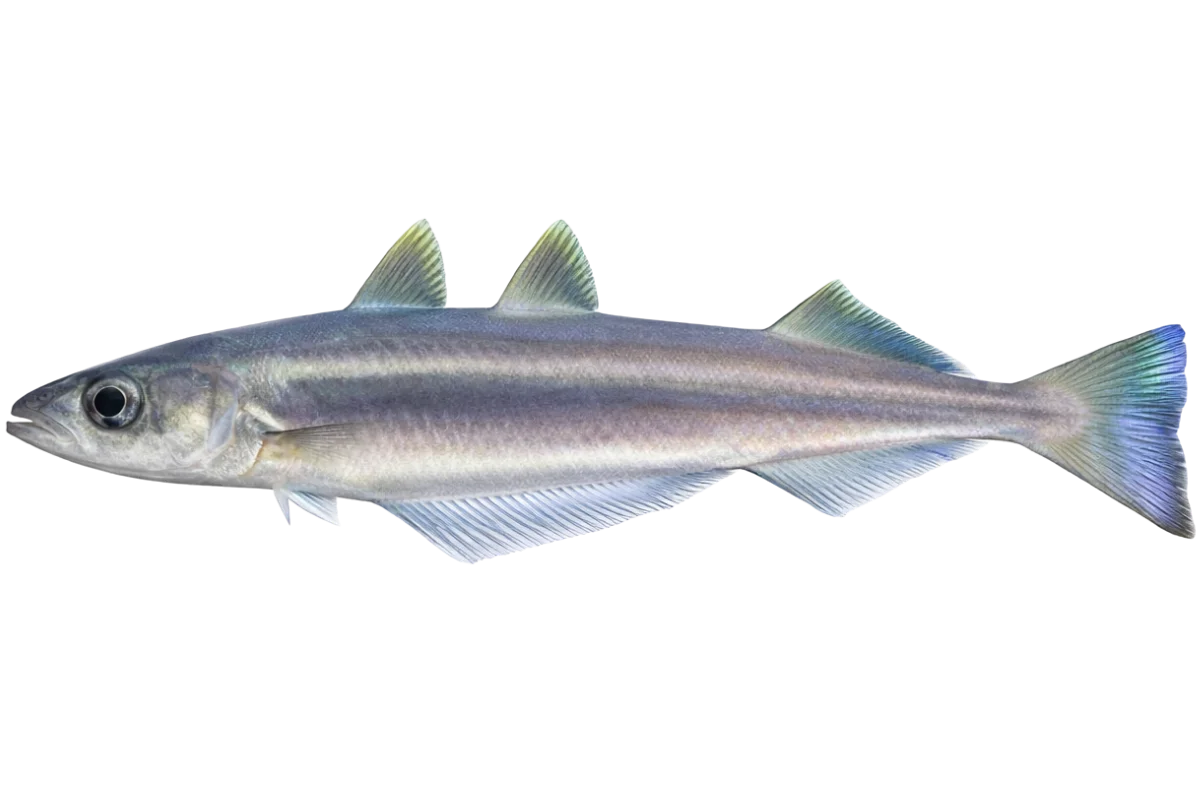
The Blue Whiting, which is also commonly referred to as the Poutassou, is a small benthopelagic fish belonging to the Gadidae family. This makes it a close relative of the European Hake and the Atlantic Cod. The body is slender and elongated with a blue-grey colour on the back that gradually turns silver and ends in white on the belly. The mouth is relatively large, and the lower jaw protrudes slightly forward.
The most defining characteristic for its identification involves the fins on the back. This feature distinguishes it from the young European Hake with which it is often confused. The Blue Whiting possesses three separate dorsal fins that are spaced apart, while the European Hake has only two. Additionally, the Blue Whiting lacks the characteristic chin barbel found in other species of the same family.
History of the Name
The regional name of this fish in certain areas has historical roots connected to modern history. This species forms massive schools, and due to its low price and abundance, it served as a staple food for the population during periods of poverty and displacement. It became associated in the public consciousness with an affordable, popular food that saved people from hunger during difficult times.
It is a deep-water fish that lives and moves at the edges of the continental shelf. During the day, it forms dense schools near the bottom at depths from 150 to 400 metres, even though it has been found as deep as 3000 metres. At night, it performs vertical migrations, rising to shallower layers of water to feed.
The Blue Whiting is an active predator of small organisms. It feeds mainly on zooplankton, specifically microscopic crustaceans such as krill and amphipods. Larger individuals also feed on small midwater fish and small cephalopods.
Fisheries & Economic Value
It is caught in bulk and almost exclusively by bottom trawlers operating in deep waters. It has low commercial value and is among the cheapest fish on the market. Nevertheless, the meat is excellent, white, tender and very delicious while strongly resembling hake. Its only disadvantage is that it is very perishable. The flesh softens very quickly after capture, so it must be consumed perfectly fresh and ideally on the same day.
The International Union for Conservation of Nature classifies the Blue Whiting as a species of Least Concern due to its massive populations. Scientific studies have highlighted its critical ecological role as a forage fish. It serves as the primary link transferring energy from plankton to apex predators, as it is the primary food for larger commercial fish and marine mammals, such as dolphins, in the Mediterranean. Research also showed that its reproductive success depends heavily on winter water temperature.
| Country | Local Name |
|---|---|
| 🇮🇹 Italy | Melù or Pesce molo |
| 🇪🇸 Spain | Bacaladilla |
| 🇫🇷 France | Poutassou |
| 🇹🇷 Turkey | Mavi mezgit |
| 🇲🇹 Malta | Marlozz |
| 🌍 North Africa (Tunisia/Libya/Egypt) | Poutassou or Samak al boros |
| 🌊 Adriatic Coast (Croatia/Slovenia) | Ugotica |
| 🇬🇷 Greece | Prosfygaki |