
Auxis rochei
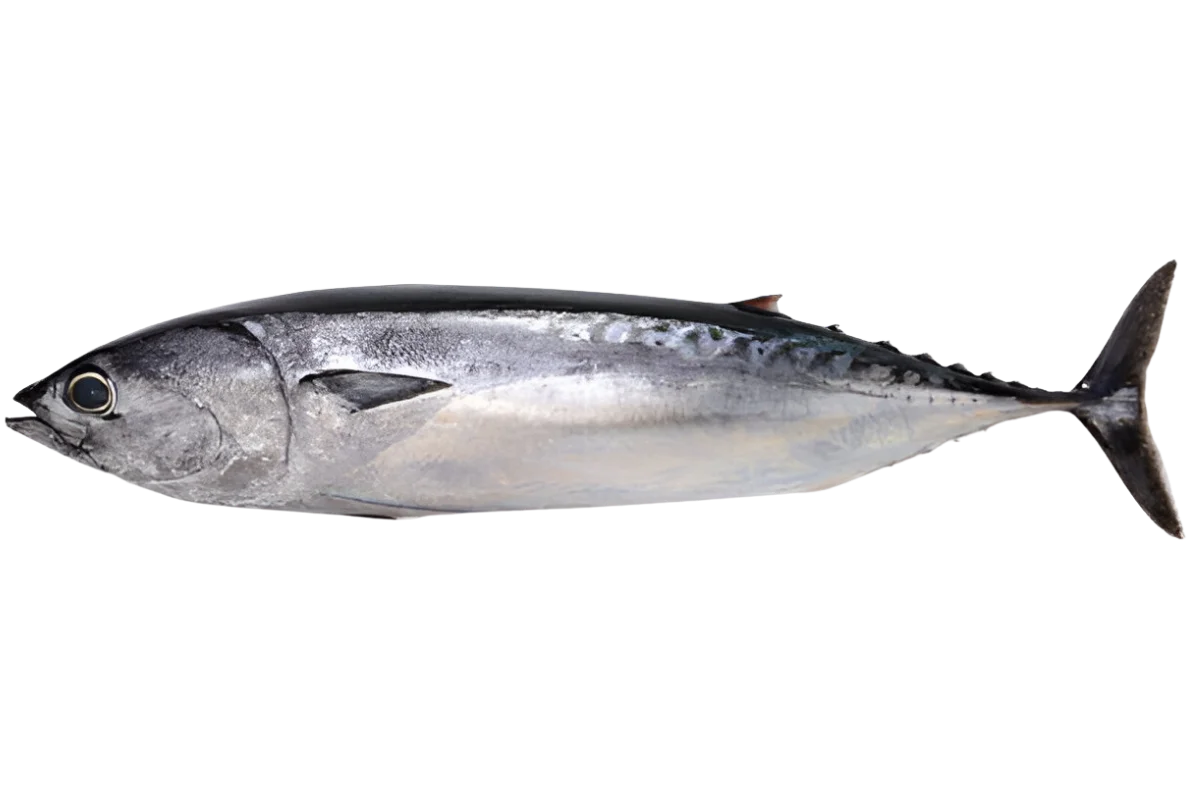
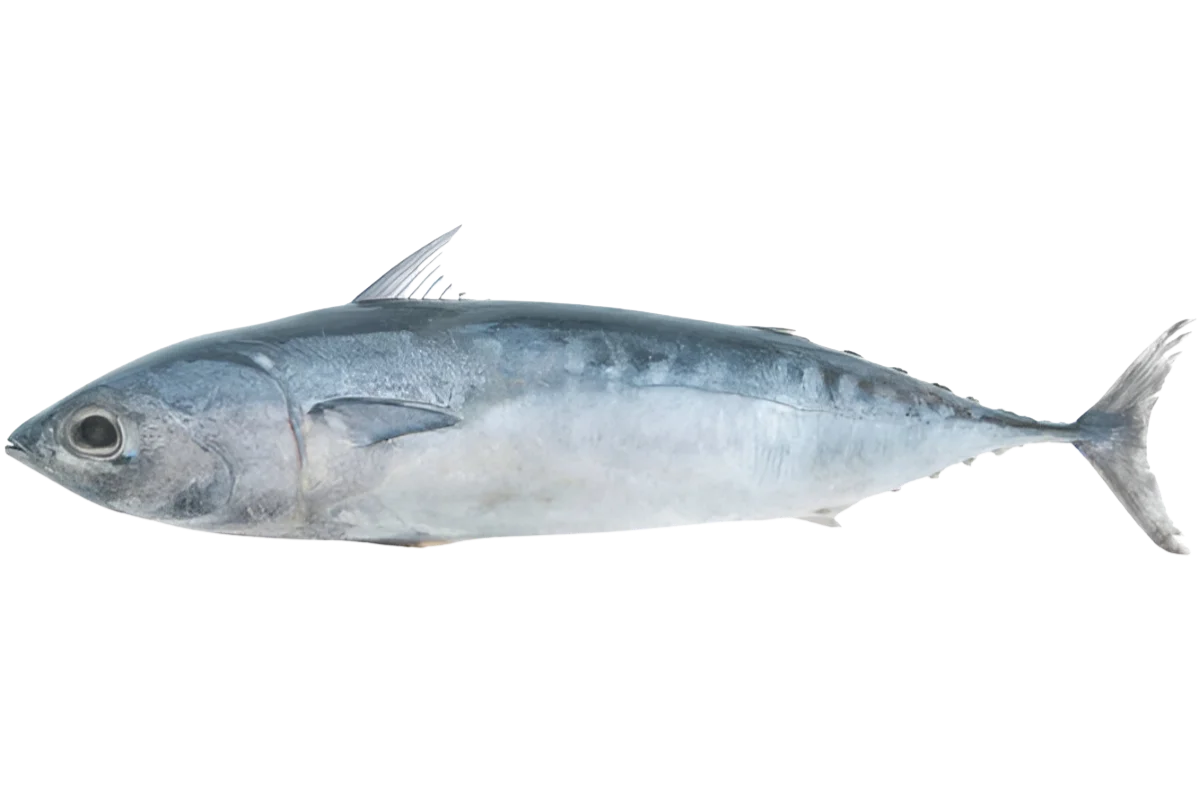
The Bullet Tuna is the smallest member of the tuna family in the Mediterranean. It is a pure pelagic fish with a very robust and round body that strongly resembles a rugby ball or a small barrel. The colour is dark blue-black on the back and silver on the belly.
The most characteristic feature that distinguishes it from the Little Tunny involves the pattern on its back. The Bullet Tuna has wide, dark, irregular zigzag stripes on the rear of the back, away from the head. Furthermore, the two dorsal fins are widely separated in the Little Tunny, whereas in the Little Tunny, they are almost joined.
This is a species of the open sea, but it frequently approaches the coast, especially in areas with deep waters and strong currents. It lives at the surface and forms massive and very dense schools that can number in the thousands. It moves constantly at high speeds.
It is a small fish compared to other tunas. The usual length is 30 to 40 centimetres, and its weight is 1 to 2 kilograms. It can reach a maximum length of 50 centimetres.
It feeds mainly on small surface fish such as anchovies and sand smelts, as well as planktonic crustaceans. It is also an important food source for larger predators such as the Atlantic Bluefin Tuna, Swordfish, and sharks.
Fisheries & Economic Value
It is caught in large quantities with purse seine nets and specific nets. For recreational fishers, it is an easy target for surface trolling when a school is located. The meat is very red and firm, with an intense blood flavour. Due to its strong flavour, it has low commercial value and is sold cheaply as small tuna. However, if it is bled correctly, it is very delicious when grilled or salted.
The International Union for Conservation of Nature classifies the Bullet Tuna as a species of Least Concern globally, although signs of overfishing are observed in certain parts of the Mediterranean. Scientific studies have highlighted its critical ecological role as a forage fish because it transfers energy from plankton to apex predators. Research on its growth confirmed that it grows very quickly and has a short life cycle of approximately 4 to 5 years. Furthermore, genetic analyses showed that Mediterranean populations exhibit genetic differentiation from those in the Atlantic, and there are indications that the fish return to the areas where they were born to reproduce.
| Country | Local Name |
|---|---|
| 🇮🇹 Italy | Tombarello |
| 🇪🇸 Spain | Melva |
| 🇫🇷 France | Auxide |
| 🇹🇷 Turkey | Gümüş orkinos |
| 🇲🇹 Malta | Tombarello |
| 🌍 North Africa (Tunisia/Libya/Egypt) | Melva or Auxide |
| 🌊 Adriatic Coast (Croatia/Slovenia) | Trup or Trupac |
| 🇬🇷 Greece | Kopani, Varelaki, or Kopania |