
Etrumeus golani
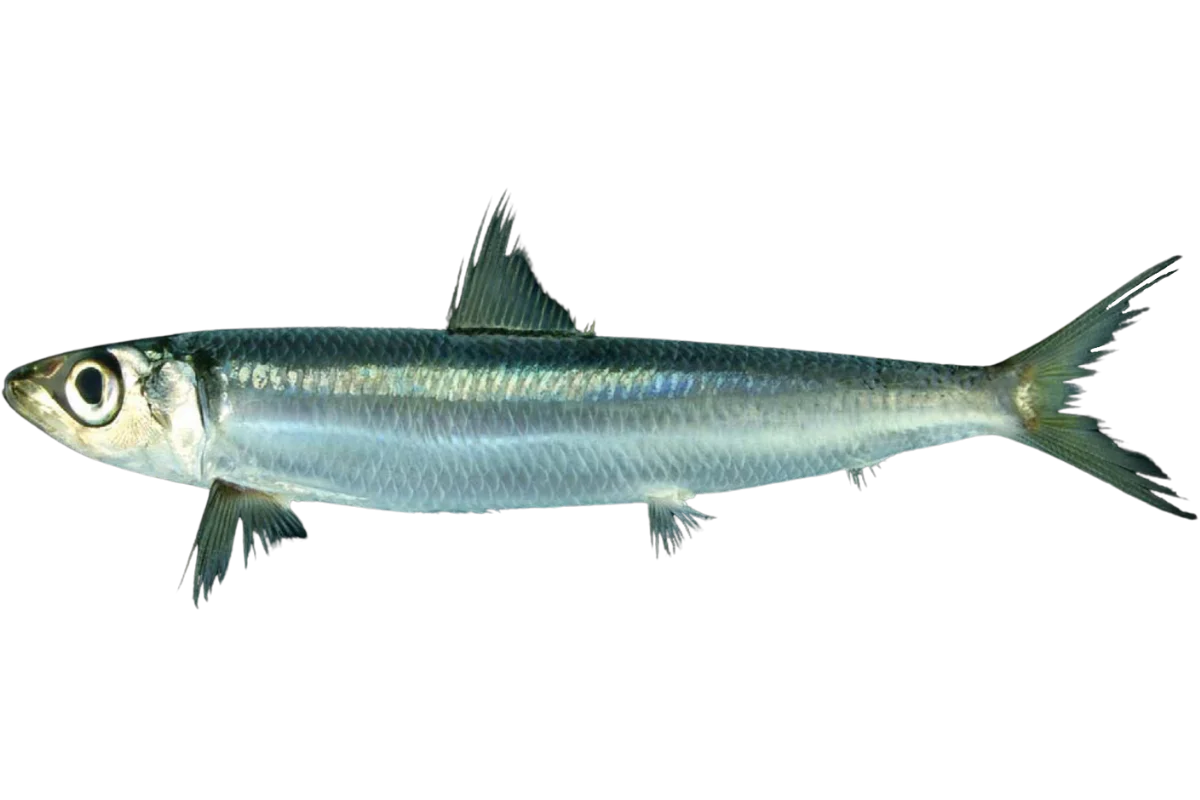
The Redeye Round Herring, also known as the Golani Round Herring or the Maray, is a small pelagic fish that is one of the most successful Lessepsian migrants in the Mediterranean. Although it superficially resembles a sardine, it has a distinctive shape that gave it its name. The body is exceptionally elongated and cylindrical, like a cigar or a tube, in contrast to the more compressed body of the sardine.
The colour on its back is an intense dark blue or bluish-green that iridises, while the sides and belly are silver. The skin is very smooth and is covered by scales that detach very easily as soon as the fish is touched. Another difference concerns the fins: the pelvic fins of the Redeye Round Herring are located entirely behind the base of the dorsal fin, whereas in the sardine, they begin below it.
It is a purely pelagic fish that lives in the open sea while forming dense schools. It arrived in the Mediterranean from the Red Sea via the Suez Canal and has established itself permanently mainly in the Eastern Mediterranean around Israel, Turkey, and Cyprus, as well as Rhodes, Crete, and the Cyclades. It usually lives at depths down to 150 metres. It represents an extremely fast swimmer and often moves to areas with strong currents.
The size of the Redeye Round Herring is slightly larger than the average sardine. The common length of capture ranges from 15 to 25 centimetres. However, it can reach and exceed 30 centimetres in length.
The animal is an active plankton-eating predator. It feeds mainly on zooplankton, which it collects from the water column. Its diet consists primarily of copepods, cladocerans, and decapod larvae such as small shrimp. Larger individuals also feed on the eggs and larvae of other fish, such as the European Anchovy.
Reproduction of the Redeye Round Herring is prolonged. In the waters of the Eastern Mediterranean, it usually starts in December and lasts until the beginning of summer, in May or June. The females release their eggs into the water in several batches.
It is caught in bulk along with other small pelagic fish such as sardines and anchovies, mainly by purse seines and secondarily by bottom trawls. It has moderate commercial value, which is lower than that of the sardine. The meat is tasty and healthy, but it has many small bones and is less fatty and less juicy than sardines. It is often used as bait for longlines and handlines because its firm body stays on the hooks well.
Until recently, the species in the Mediterranean was referred to as Etrumeus teres. However, genetic studies have shown that the populations of the Mediterranean and the Red Sea are distinct species and are now scientifically named Etrumeus golani in honour of the ichthyologist Dani Golani. Research shows that the genetic diversity of the Mediterranean population is very high, indicating multiple waves of migration from the Red Sea rather than a single one, which has made the species extremely successful and resilient in its new environment.
| Country | Local Name |
|---|---|
| 🇮🇹 Italy | Aringa tonda |
| 🇪🇸 Spain | Arenque redondo |
| 🇫🇷 France | Shadine |
| 🇹🇷 Turkey | Kizilgözlü sardalya |
| 🇲🇹 Malta | Sardina tonda |
| 🌍 North Africa (Tunisia/Libya/Egypt) | Samak al sardina or Shadine |
| 🇮🇱 Israel | Golani Round Herring |
| 🇬🇷 Greece | Strongyloregga |