
Albacore or Little Tunny: how to tell them apart
The two fish next to each other, fact by fact.
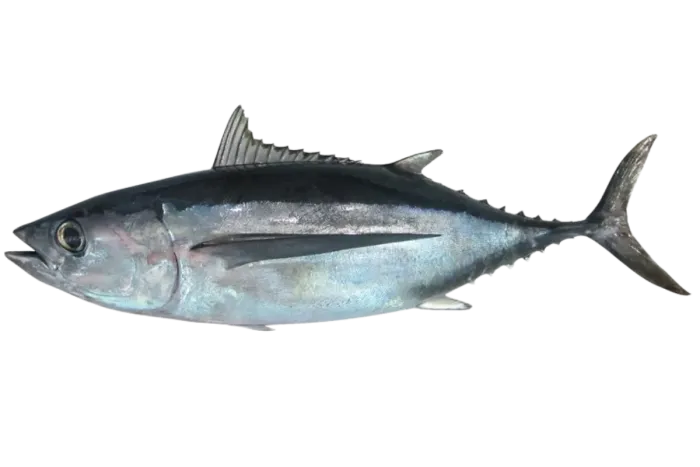 Albacore
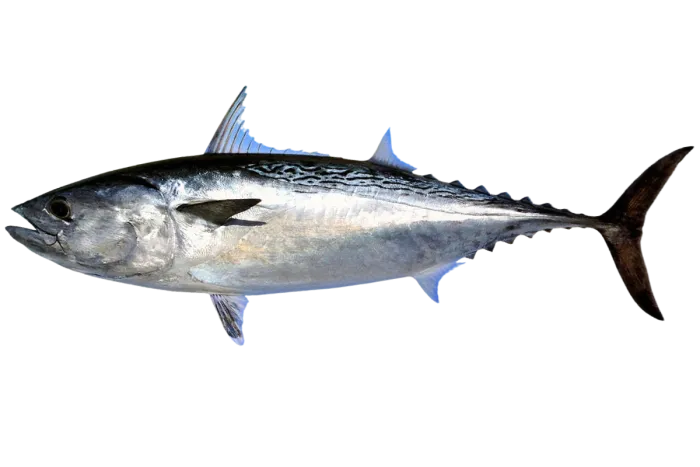 Little Tunny
How to tell them apart
The Little Tunny has dark wavy lines on the rear part of the back and a few black spots below the side fin. The Albacore has a plain back with no markings and very long side fins.
Scientific name
Albacore
Thunnus alalunga
Little Tunny
Euthynnus alletteratus
Also known as
Albacore
Makrypterygos Tonos, Alalunga, Tonaki
Little Tunny
Karvouni, Tonina, Lekatiki
Is it eaten?
Albacore
Yes
Little Tunny
Yes
Is it dangerous?
Albacore
No
Little Tunny
No
Usual size
Albacore
60 to 100 cm
Little Tunny
60 to 80 cm
Fishing season
Albacore
June to October
Little Tunny
June to November
Category
Albacore
Pelagic & Open Sea Fish
Little Tunny
Pelagic & Open Sea Fish
Conservation status
Albacore
Least Concern (LC)
Little Tunny
Least Concern (LC)
What it looks like
Albacore
The Albacore is one of the most valuable and elegant pelagic fish crossing the Mediterranean. It is widely known as Alalunga, which derives from its scientific name and means "long wing," while fishers also call it "small tuna." The body is hydrodynamic and torpedo-shaped, with a dark metallic blue colour on the back and silver-white on the belly.
Little Tunny
The Little Tunny is a powerful and fast pelagic fish belonging to the Scombridae family. It is the most common tuna species in the Mediterranean coastal waters and is frequently confused with the Atlantic Bonito or the Albacore. However, it possesses unique characteristics that make it instantly recognisable. The body is robust and hydrodynamic with a dark blue or metallic colour on the back and silver on the belly.
Where it lives
Albacore
This is a purely pelagic and migratory species that lives in the open sea and rarely approaches the coast. It prefers deep, clear waters, moving over a wide depth range from the surface down to 600 metres in search of food and suitable temperatures. It forms large schools that travel constantly, covering huge distances across the Mediterranean and the Atlantic Ocean.
Little Tunny
This is an epipelagic species that prefers warm and temperate waters. It lives mainly in coastal regions of the neritic zone but also in the open sea, where it forms large, very compact schools, often alongside other tuna species. It is extremely mobile and performs extensive migrations while following warm currents and its food.
Everything about Albacore Everything about Little Tunny
More fish that get mixed up
- Albacore or Atlantic Bluefin Tuna
- Anchovy or Pilchard
- Angular Roughshark or Spiny Dogfish
- Atlantic Bonito or Little Tunny
- Atlantic Mackerel or Chub Mackerel
- Blue Runner or Horse Mackerel
- Blue Whiting or Hake
- Brill or Turbot
- Broadtail Shortfin Squid or Squid
- Brown Comber or Comber
- Comber or Painted Comber
- Conger or Eel
- Dogtooth Grouper or White Grouper
- Dogtooth Grouper or Wreckfish
- Dusky Grouper or Mottled Grouper
- Flying Fish or Flying Gurnard
- Garfish or Halfbeak
- Greater Amberjack or Leerfish
- Mediterranean Spearfish or Swordfish
- Nursehound or Small spotted Catshark
- Pilchard or Round Sardinella
- Red Mullet or Striped Red Mullet
- Stingray or Thornback Ray