
Brill or Turbot: how to tell them apart
The two fish next to each other, fact by fact.
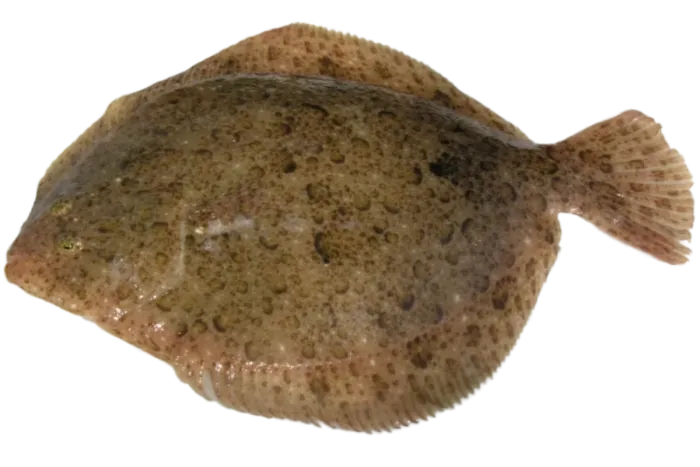 Brill
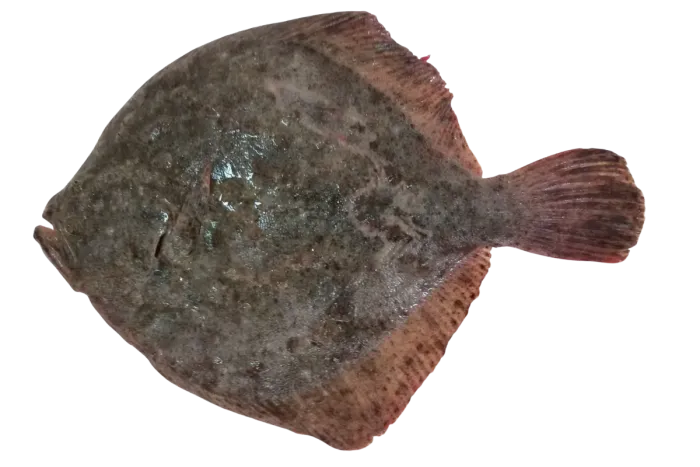 Turbot
How to tell them apart
Run your hand over the dark side. The Turbot has no scales but hard bony bumps, and its body is almost round. The Brill has smooth skin with small scales and a more oval body, and the first rays of the back fin near the mouth look like a fringe.
Scientific name
Brill
Scophthalmus rhombus
Turbot
Scophthalmus maximus
Also known as
Brill
Remvos, Pisi
Turbot
Kalkani
Is it eaten?
Brill
Yes
Turbot
Yes
Is it dangerous?
Brill
No
Turbot
No
Usual size
Brill
30 to 50 cm
Turbot
40 to 60 cm
Fishing season
Brill
February to May
Turbot
February to May
Category
Brill
Rays & Flatfish
Turbot
Rays & Flatfish
Conservation status
Brill
Least Concern (LC)
Turbot
Least Concern (LC)
What it looks like
Brill
The Brill, which is also frequently referred to as the Barbue, is a large flatfish belonging to the Scophthalmidae family. It is the closest relative of the Turbot and closely resembles it in both appearance and meat quality. Like the Turbot, the Brill is a left-eyed flatfish, meaning both eyes are on the left side of its body. This side faces upward when the fish is lying on the seabed.
Turbot
The Turbot is the undisputed king of flatfish in the Mediterranean, and it is distinguished by the almost circular shape of its body. It belongs to the Scophthalmidae family and is characterised as a left-eyed flatfish. This means that during its metamorphosis, the right eye moves to the left side of the head. The most defining feature that separates it from all other flatfish is the complete lack of scales.
Where it lives
Brill
It lives exclusively on the bottom and prefers sandy and muddy seabeds where it can bury itself slightly. The fish is usually encountered at depths from 5 to 50 metres. It is a euryhaline species, which means it can tolerate changes in salinity and consequently often enters river estuaries and brackish waters to feed.
Turbot
This species lives exclusively on the seabed and loves to be camouflaged. It prefers sandy, muddy, or mixed seabeds with gravel, where it can bury itself slightly and become one with the environment. It is usually found at depths ranging from 10 to 80 metres, although it can descend deeper. It has a high tolerance for low salinity, which is why it is often found in brackish waters and river estuaries.
Everything about Brill Everything about Turbot
More fish that get mixed up
- Albacore or Atlantic Bluefin Tuna
- Albacore or Little Tunny
- Anchovy or Pilchard
- Angular Roughshark or Spiny Dogfish
- Atlantic Bonito or Little Tunny
- Atlantic Mackerel or Chub Mackerel
- Blue Runner or Horse Mackerel
- Blue Whiting or Hake
- Broadtail Shortfin Squid or Squid
- Brown Comber or Comber
- Comber or Painted Comber
- Conger or Eel
- Dogtooth Grouper or White Grouper
- Dogtooth Grouper or Wreckfish
- Dusky Grouper or Mottled Grouper
- Flying Fish or Flying Gurnard
- Garfish or Halfbeak
- Greater Amberjack or Leerfish
- Mediterranean Spearfish or Swordfish
- Nursehound or Small spotted Catshark
- Pilchard or Round Sardinella
- Red Mullet or Striped Red Mullet
- Stingray or Thornback Ray