
Comber or Painted Comber: how to tell them apart
The two fish next to each other, fact by fact.
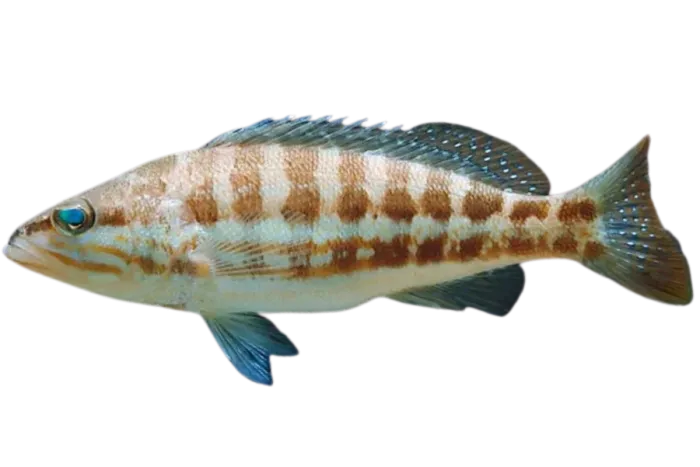 Comber
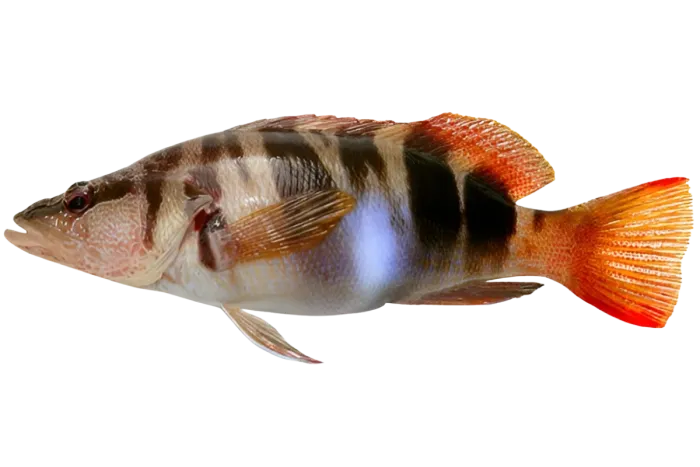 Painted Comber
How to tell them apart
The Painted Comber has a blue to violet patch on the belly and fine blue and red lines on the head that look like writing. The Comber has no blue patch and stands out for the yellow or orange lines running along its body.
Scientific name
Comber
Serranus cabrilla
Painted Comber
Serranus scriba
Also known as
Comber
Chanos
Painted Comber
Perka, Grammatikos
Is it eaten?
Comber
Yes
Painted Comber
Yes
Is it dangerous?
Comber
No
Painted Comber
No
Usual size
Comber
15 to 25 cm
Painted Comber
15 to 25 cm
Fishing season
Comber
All year round
Painted Comber
March to November
Category
Comber
Reef & Rocky Bottom Fish
Painted Comber
Reef & Rocky Bottom Fish
Conservation status
Comber
Least Concern (LC)
Painted Comber
Least Concern (LC)
What it looks like
Comber
The Comber, which is also widely known as the Gaper, is one of the most common, gluttonous, and adaptable fish of the regional seabeds. It belongs to the Serranidae family and is a cousin of the groupers and the painted Comber. The body is elongated and slightly compressed, with colour that varies significantly with depth and environment, usually ranging from reddish-brown to yellow-orange.
Painted Comber
The Painted Comber, which is also commonly referred to as the Scribbled Comber or the Lettered Comber, is one of the most common, beautiful, and curious bottom-dwelling fish of the Mediterranean. It belongs to the Serranidae family, which makes it a close relative of the grouper, and it is famous for its vivid colours. The body is robust and compressed laterally, with a beige-brown colour.
Where it lives
Comber
This represents the most adaptable benthic species of the Mediterranean. It lives literally everywhere on rocky bottoms, in Posidonia seagrass meadows, on sandy areas, and on muddy seabeds. The depth range in which it occurs is impressive, ranging from shallow waters of 5 metres to 500 metres. It is a solitary and territorial fish.
Painted Comber
It is one of the most common fish on rocky bottoms and in Posidonia seagrass meadows. It lives in shallow coastal waters, usually at depths from one to 30 metres, although it can reach up to 150 metres. It is an extremely territorial fish and is often seen standing still over a rock or hole, observing its surroundings. It does not frighten easily and often approaches divers out of curiosity.
Everything about Comber Everything about Painted Comber
More fish that get mixed up
- Albacore or Atlantic Bluefin Tuna
- Albacore or Little Tunny
- Anchovy or Pilchard
- Angular Roughshark or Spiny Dogfish
- Atlantic Bonito or Little Tunny
- Atlantic Mackerel or Chub Mackerel
- Blue Runner or Horse Mackerel
- Blue Whiting or Hake
- Brill or Turbot
- Broadtail Shortfin Squid or Squid
- Brown Comber or Comber
- Conger or Eel
- Dogtooth Grouper or White Grouper
- Dogtooth Grouper or Wreckfish
- Dusky Grouper or Mottled Grouper
- Flying Fish or Flying Gurnard
- Garfish or Halfbeak
- Greater Amberjack or Leerfish
- Mediterranean Spearfish or Swordfish
- Nursehound or Small spotted Catshark
- Pilchard or Round Sardinella
- Red Mullet or Striped Red Mullet
- Stingray or Thornback Ray