
Flying Fish or Flying Gurnard: how to tell them apart
The two fish next to each other, fact by fact.
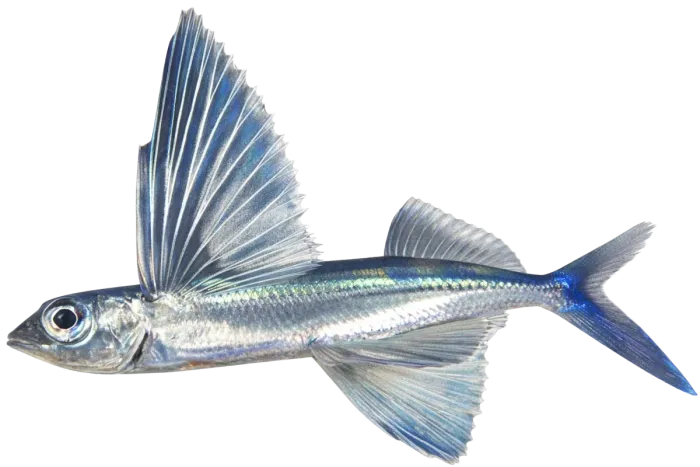 Flying Fish
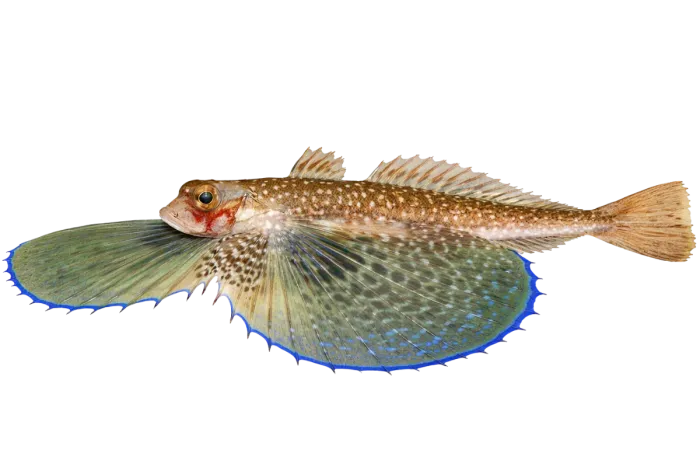 Flying Gurnard
How to tell them apart
The Flying Fish is slim, silver and blue, lives at the surface and really does fly above the water. The Flying Gurnard lives on the seabed, has a heavy head like a helmet and huge round fins with blue spots that it opens like a fan. The Flying Gurnard does not fly.
Scientific name
Flying Fish
Cheilopogon heterurus / Parexocoetus mento
Flying Gurnard
Dactylopterus volitans
Also known as
Flying Fish
Chelidonopsaro
Flying Gurnard
Chelidonas
Is it eaten?
Flying Fish
Yes
Flying Gurnard
Yes
Is it dangerous?
Flying Fish
No
Flying Gurnard
No
Usual size
Flying Fish
15 to 30 cm
Flying Gurnard
20 to 35 cm
Category
Flying Fish
Pelagic & Open Sea Fish
Flying Gurnard
Reef & Rocky Bottom Fish
Invasive species
Flying Fish
Yes
Flying Gurnard
No
Conservation status
Flying Fish
Least Concern (LC)
Flying Gurnard
Least Concern (LC)
What it looks like
Flying Fish
The Flying Fish is a true marvel of natural engineering. It is the only fish capable of emerging from the water and performing actual flights to escape predators while covering breathtaking distances. The body is elongated and silver-blue, resembling a torpedo. The secret of its flight lies in the fins. Its pectoral fins are huge and function exactly like the wings of a glider.
Flying Gurnard
The Flying Gurnard, which is also widely known as the Helmet Gurnard or simply the Swallow Fish, is one of the most impressive and misunderstood fish of the seabed. It belongs to the Dactylopteridae family. Its name is due to the huge pectoral fins that look like the wings of a swallow or a butterfly.
Where it lives
Flying Fish
This is a purely epipelagic species. It lives exclusively in the blue zone of the open sea in the first few metres below the surface, from zero to 20 metres. It rarely approaches the coasts unless the waters are deep. We often see them jumping in front of the bows of ships travelling in the open sea.
Flying Gurnard
This is an exclusively bottom-dwelling species. It lives on sandy and muddy seabeds, as well as near Posidonia seagrass meadows and rocky areas. It is usually encountered at depths of 1 to 100 metres. It represents a solitary fish that spends its time slowly walking on the floor, searching for food.
Everything about Flying Fish Everything about Flying Gurnard
More fish that get mixed up
- Albacore or Atlantic Bluefin Tuna
- Albacore or Little Tunny
- Anchovy or Pilchard
- Angular Roughshark or Spiny Dogfish
- Atlantic Bonito or Little Tunny
- Atlantic Mackerel or Chub Mackerel
- Blue Runner or Horse Mackerel
- Blue Whiting or Hake
- Brill or Turbot
- Broadtail Shortfin Squid or Squid
- Brown Comber or Comber
- Comber or Painted Comber
- Conger or Eel
- Dogtooth Grouper or White Grouper
- Dogtooth Grouper or Wreckfish
- Dusky Grouper or Mottled Grouper
- Garfish or Halfbeak
- Greater Amberjack or Leerfish
- Mediterranean Spearfish or Swordfish
- Nursehound or Small spotted Catshark
- Pilchard or Round Sardinella
- Red Mullet or Striped Red Mullet
- Stingray or Thornback Ray