
Mediterranean Spearfish or Swordfish: how to tell them apart
The two fish next to each other, fact by fact.
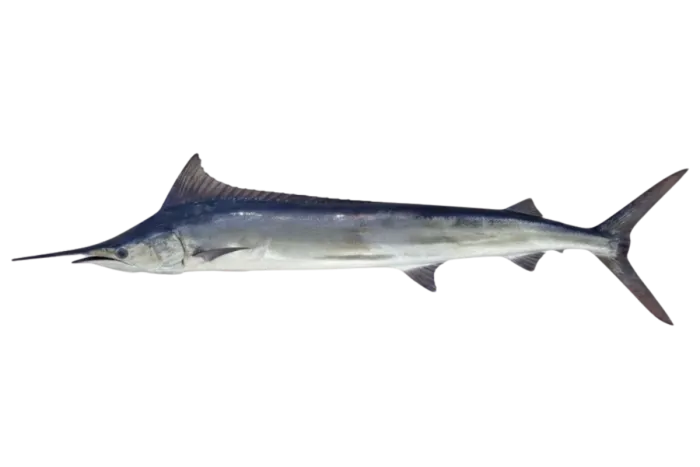 Mediterranean Spearfish
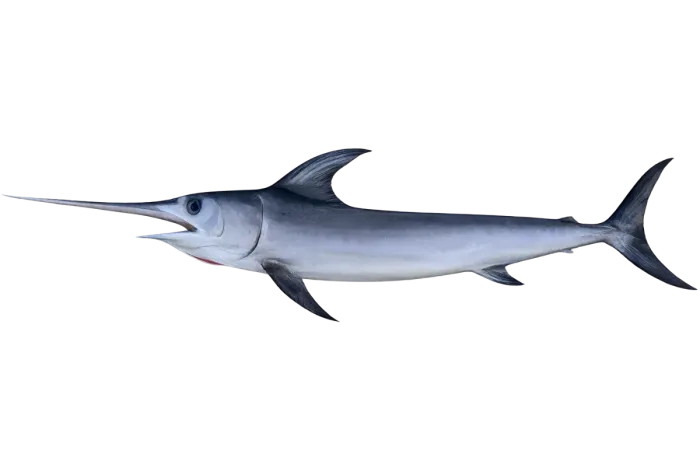 Swordfish
How to tell them apart
The Swordfish has a long sword, flat like a blade, and no fins at all on the belly. The Mediterranean Spearfish has a much shorter, rounded bill, one long fin along almost the whole back and two thin, long fins on the belly.
Scientific name
Mediterranean Spearfish
Tetrapturus belone
Swordfish
Xiphias gladius
Also known as
Mediterranean Spearfish
Marlinos tis Mesogeiou, Mesogeiako Lonchopsaro
Swordfish
Xifias
Is it eaten?
Mediterranean Spearfish
Yes
Swordfish
Yes
Is it dangerous?
Mediterranean Spearfish
No
Swordfish
No
Category
Mediterranean Spearfish
Pelagic & Open Sea Fish
Swordfish
Pelagic & Open Sea Fish
Conservation status
Mediterranean Spearfish
Least Concern (LC)
Swordfish
Near Threatened (NT)
What it looks like
Mediterranean Spearfish
The Mediterranean Spearfish is an impressive, large pelagic fish belonging to the family Istiophoridae. It represents the regional equivalent of the great marlins found in the oceans, but it is specifically adapted to the waters of the Mediterranean. It is frequently confused with the Swordfish, even though it possesses fundamental differences.
Swordfish
The Swordfish, also known as the Broadbill or Broadbill Swordfish, is the absolute gladiator of the open sea and one of the most iconic fish in the world. It represents the sole member of the Xiphiidae family. The body is robust and round at the front, tapering toward the tail to take on a hydrodynamic shape.
Where it lives
Mediterranean Spearfish
This is one of the few large pelagic species considered endemic to the Mediterranean, meaning it lives and reproduces almost exclusively in this sea and does not migrate to the Atlantic Ocean. It lives in the open sea, far from the coast, and usually moves in the upper water layers from the surface down to a depth of 200 metres.
Swordfish
It is a cosmopolitan and highly migratory pelagic species that lives in the open sea. It has a high tolerance to temperature changes and moves across a wide depth range from the surface down to 800 metres or deeper. It performs characteristic vertical migrations, meaning that during the day it descends to great depths to hunt in cold waters, and at night it rises to the warmer surface layers to feed.
Everything about Mediterranean Spearfish Everything about Swordfish
More fish that get mixed up
- Albacore or Atlantic Bluefin Tuna
- Albacore or Little Tunny
- Anchovy or Pilchard
- Angular Roughshark or Spiny Dogfish
- Atlantic Bonito or Little Tunny
- Atlantic Mackerel or Chub Mackerel
- Blue Runner or Horse Mackerel
- Blue Whiting or Hake
- Brill or Turbot
- Broadtail Shortfin Squid or Squid
- Brown Comber or Comber
- Comber or Painted Comber
- Conger or Eel
- Dogtooth Grouper or White Grouper
- Dogtooth Grouper or Wreckfish
- Dusky Grouper or Mottled Grouper
- Flying Fish or Flying Gurnard
- Garfish or Halfbeak
- Greater Amberjack or Leerfish
- Nursehound or Small spotted Catshark
- Pilchard or Round Sardinella
- Red Mullet or Striped Red Mullet
- Stingray or Thornback Ray