
Brown Comber or Comber: how to tell them apart
The two fish next to each other, fact by fact.
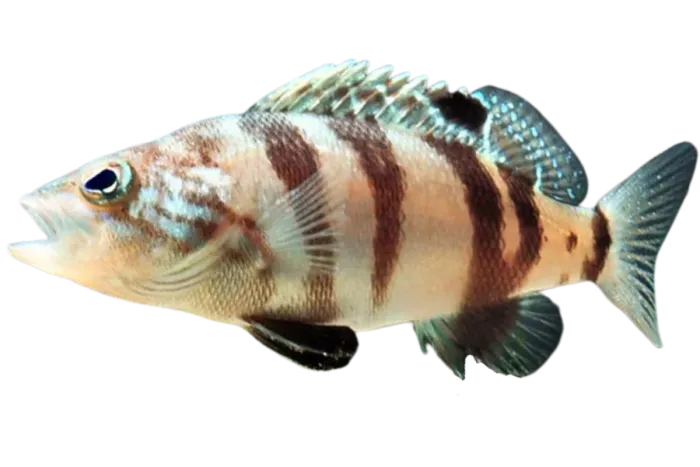 Brown Comber
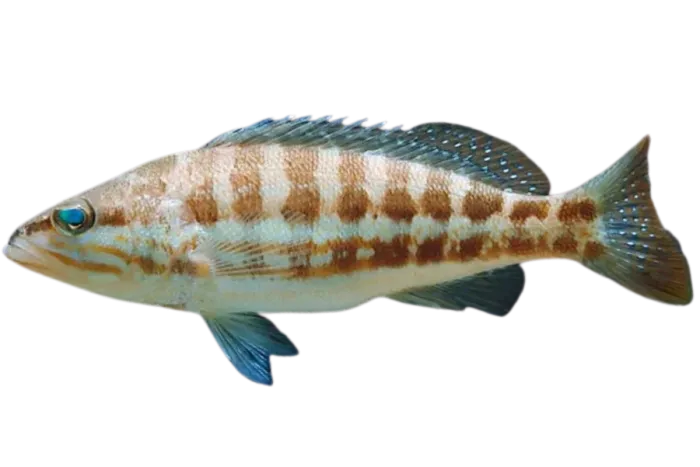 Comber
How to tell them apart
The Brown Comber is small, usually under 15 cm, with a deep body and a black spot on the back fin. The Comber is longer and larger, has no black spot, and shows yellow or orange lines running along the body over its dark vertical bars.
Scientific name
Brown Comber
Serranus hepatus
Comber
Serranus cabrilla
Also known as
Brown Comber
Chanoui
Comber
Chanos
Is it eaten?
Brown Comber
No
Comber
Yes
Is it dangerous?
Brown Comber
No
Comber
No
Usual size
Brown Comber
5 to 10 cm
Comber
15 to 25 cm
Fishing season
Brown Comber
No data
Comber
All year round
Category
Brown Comber
Reef & Rocky Bottom Fish
Comber
Reef & Rocky Bottom Fish
Conservation status
Brown Comber
Least Concern (LC)
Comber
Least Concern (LC)
What it looks like
Brown Comber
The Brown Comber, which is also commonly referred to as the Dwarf Bass, is the smallest member of the Serranidae family in the Mediterranean, meaning it represents the little brother of the comber, the painted comber, and the dusky grouper. It is a small and pleasant fish that often goes unnoticed due to its size and cryptic lifestyle.
Comber
The Comber, which is also widely known as the Gaper, is one of the most common, gluttonous, and adaptable fish of the regional seabeds. It belongs to the Serranidae family and is a cousin of the groupers and the painted Comber. The body is elongated and slightly compressed, with colour that varies significantly with depth and environment, usually ranging from reddish-brown to yellow-orange.
Where it lives
Brown Comber
This is a benthic species that lives near the bottom. It prefers sandy and muddy seabeds as well as Posidonia seagrass meadows, where it can hide among the vegetation. It is encountered at depths ranging from 5 metres to 100 metres. It represents a solitary fish and does not stray far from its specific territory.
Comber
This represents the most adaptable benthic species of the Mediterranean. It lives literally everywhere on rocky bottoms, in Posidonia seagrass meadows, on sandy areas, and on muddy seabeds. The depth range in which it occurs is impressive, ranging from shallow waters of 5 metres to 500 metres. It is a solitary and territorial fish.
Everything about Brown Comber Everything about Comber
More fish that get mixed up
- Albacore or Atlantic Bluefin Tuna
- Albacore or Little Tunny
- Anchovy or Pilchard
- Angular Roughshark or Spiny Dogfish
- Atlantic Bonito or Little Tunny
- Atlantic Mackerel or Chub Mackerel
- Blue Runner or Horse Mackerel
- Blue Whiting or Hake
- Brill or Turbot
- Broadtail Shortfin Squid or Squid
- Comber or Painted Comber
- Conger or Eel
- Dogtooth Grouper or White Grouper
- Dogtooth Grouper or Wreckfish
- Dusky Grouper or Mottled Grouper
- Flying Fish or Flying Gurnard
- Garfish or Halfbeak
- Greater Amberjack or Leerfish
- Mediterranean Spearfish or Swordfish
- Nursehound or Small spotted Catshark
- Pilchard or Round Sardinella
- Red Mullet or Striped Red Mullet
- Stingray or Thornback Ray