
Atlantic Bonito or Little Tunny: how to tell them apart
The two fish next to each other, fact by fact.
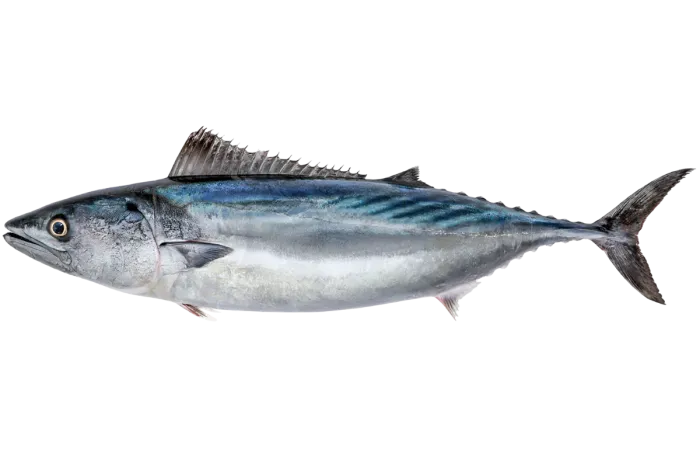 Atlantic Bonito
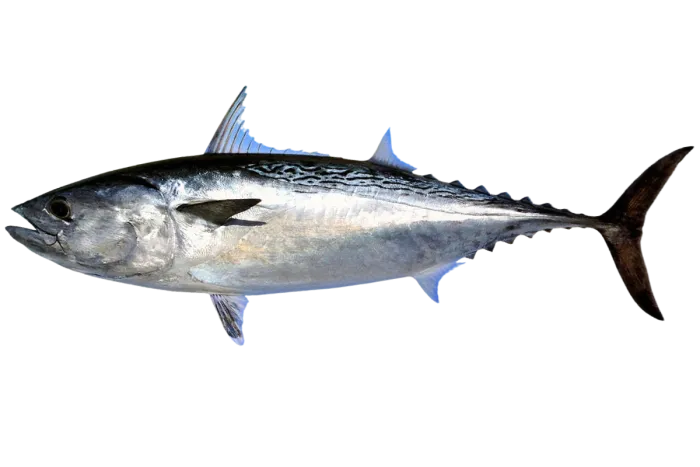 Little Tunny
How to tell them apart
The Atlantic Bonito has straight, slanting dark stripes all along the back and a clean silver belly. The Little Tunny has wavy markings only on the rear part of the back and a few black spots below the side fin. The Little Tunny is also stockier.
Scientific name
Atlantic Bonito
Sarda sarda
Little Tunny
Euthynnus alletteratus
Also known as
Atlantic Bonito
Palamida, Rikia, Torikia
Little Tunny
Karvouni, Tonina, Lekatiki
Is it eaten?
Atlantic Bonito
Yes
Little Tunny
Yes
Is it dangerous?
Atlantic Bonito
No
Little Tunny
No
Usual size
Atlantic Bonito
30 to 50 cm
Little Tunny
60 to 80 cm
Fishing season
Atlantic Bonito
August to December
Little Tunny
June to November
Category
Atlantic Bonito
Pelagic & Open Sea Fish
Little Tunny
Pelagic & Open Sea Fish
Conservation status
Atlantic Bonito
Least Concern (LC)
Little Tunny
Least Concern (LC)
What it looks like
Atlantic Bonito
The Atlantic Bonito, which is also commonly referred to as the Common Bonito or the Sarda or simply the Bonito, is one of the most well-known, fastest, and commercially significant fish of the Scombridae family. This family also includes the tunas. The body is hydrodynamic and spindle-shaped, designed to cut through water at high speeds. The colour is metallic blue on the back and silver on the belly.
Little Tunny
The Little Tunny is a powerful and fast pelagic fish belonging to the Scombridae family. It is the most common tuna species in the Mediterranean coastal waters and is frequently confused with the Atlantic Bonito or the Albacore. However, it possesses unique characteristics that make it instantly recognisable. The body is robust and hydrodynamic with a dark blue or metallic colour on the back and silver on the belly.
Where it lives
Atlantic Bonito
This is an epipelagic and migratory species that forms large, dense schools, often sorted by size. It lives in the open sea and also in coastal waters, usually at depths from the surface down to 200 metres. The fish travels constantly while searching for food and suitable temperatures, and it often approaches the coast very closely to chase schools of small fish into bays.
Little Tunny
This is an epipelagic species that prefers warm and temperate waters. It lives mainly in coastal regions of the neritic zone but also in the open sea, where it forms large, very compact schools, often alongside other tuna species. It is extremely mobile and performs extensive migrations while following warm currents and its food.
Everything about Atlantic Bonito Everything about Little Tunny
More fish that get mixed up
- Albacore or Atlantic Bluefin Tuna
- Albacore or Little Tunny
- Anchovy or Pilchard
- Angular Roughshark or Spiny Dogfish
- Atlantic Mackerel or Chub Mackerel
- Blue Runner or Horse Mackerel
- Blue Whiting or Hake
- Brill or Turbot
- Broadtail Shortfin Squid or Squid
- Brown Comber or Comber
- Comber or Painted Comber
- Conger or Eel
- Dogtooth Grouper or White Grouper
- Dogtooth Grouper or Wreckfish
- Dusky Grouper or Mottled Grouper
- Flying Fish or Flying Gurnard
- Garfish or Halfbeak
- Greater Amberjack or Leerfish
- Mediterranean Spearfish or Swordfish
- Nursehound or Small spotted Catshark
- Pilchard or Round Sardinella
- Red Mullet or Striped Red Mullet
- Stingray or Thornback Ray