
Anchovy or Pilchard: how to tell them apart
The two fish next to each other, fact by fact.
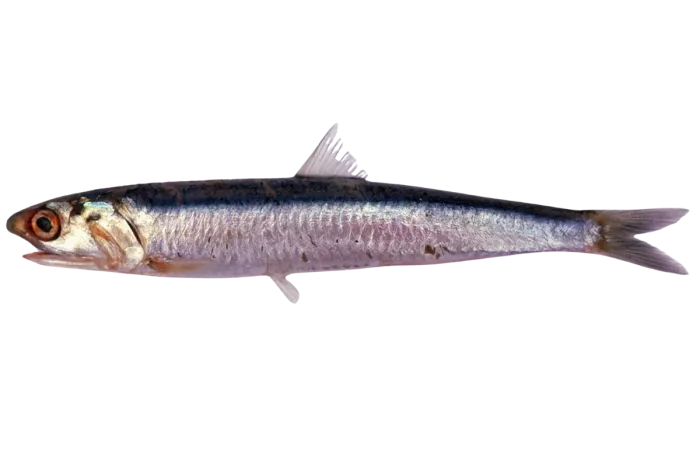 Anchovy
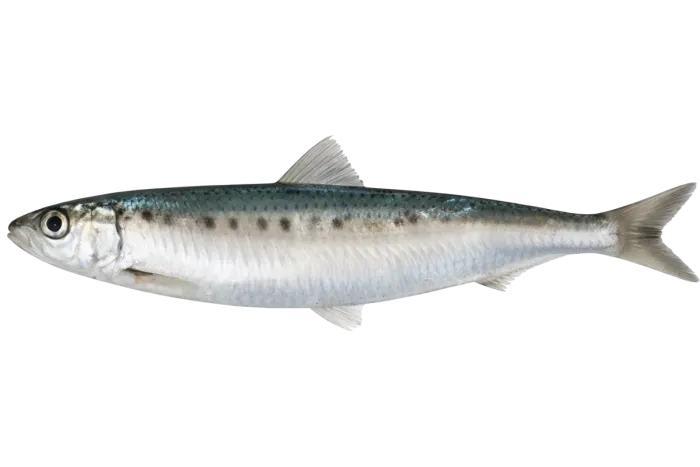 Pilchard
How to tell them apart
The Anchovy is slim and round, with a pointed snout that sticks out and a very large mouth reaching behind the eye. The Pilchard is deeper and flatter, with large scales that come off easily and a belly that feels rough like a saw when you run a finger along it.
Scientific name
Anchovy
Engraulis encrasicolus
Pilchard
Sardina pilchardus
Also known as
Anchovy
Gavros, Antzougia, Chapsi
Pilchard
Sardela
Is it eaten?
Anchovy
Yes
Pilchard
Yes
Is it dangerous?
Anchovy
No
Pilchard
No
Usual size
Anchovy
No data
Pilchard
10 to 15 cm
Fishing season
Anchovy
April to October
Pilchard
May to October
Category
Anchovy
Pelagic & Open Sea Fish
Pilchard
Pelagic & Open Sea Fish
Conservation status
Anchovy
Least Concern (LC)
Pilchard
Least Concern (LC)
What it looks like
Anchovy
The European Anchovy is the most abundant and popular small fish in the region, and it forms the basis of the marine food chain. The body is elongated and round, and it features a brilliant blue-green colour on the back with a silver lateral band that shines intensely. Its most distinctive feature is the head, which has a snout that protrudes over the mouth, similar to a shark's.
Pilchard
The European Pilchard, which is also widely known as the Sardine, is undoubtedly the most iconic small pelagic fish of the Mediterranean. It is a foundation species in the marine ecosystem, serving as a primary food source for countless predators and a nutritional treasure for humans. It is famous for its rich flavour and high content of Omega-3 fatty acids.
Where it lives
Anchovy
This is a purely pelagic fish that lives in the open sea. During the summer months, it moves near the surface at depths from zero to fifty metres, while in winter, it descends to great depths, reaching up to four hundred metres, to find a stable temperature. It is a species that can withstand large changes in salinity, and this is why it often approaches river estuaries and lagoons.
Pilchard
This is a purely pelagic species that lives in the open sea. It forms massive, dense schools that can consist of thousands or even millions of individuals, which move in synchrony to confuse predators. It exhibits strong vertical migration behaviour. During the day, it descends to greater depths, usually between 25 and 55 metres, though it can reach 100 metres for safety.
Everything about Anchovy Everything about Pilchard
More fish that get mixed up
- Albacore or Atlantic Bluefin Tuna
- Albacore or Little Tunny
- Angular Roughshark or Spiny Dogfish
- Atlantic Bonito or Little Tunny
- Atlantic Mackerel or Chub Mackerel
- Blue Runner or Horse Mackerel
- Blue Whiting or Hake
- Brill or Turbot
- Broadtail Shortfin Squid or Squid
- Brown Comber or Comber
- Comber or Painted Comber
- Conger or Eel
- Dogtooth Grouper or White Grouper
- Dogtooth Grouper or Wreckfish
- Dusky Grouper or Mottled Grouper
- Flying Fish or Flying Gurnard
- Garfish or Halfbeak
- Greater Amberjack or Leerfish
- Mediterranean Spearfish or Swordfish
- Nursehound or Small spotted Catshark
- Pilchard or Round Sardinella
- Red Mullet or Striped Red Mullet
- Stingray or Thornback Ray