
Blue Whiting or Hake: how to tell them apart
The two fish next to each other, fact by fact.
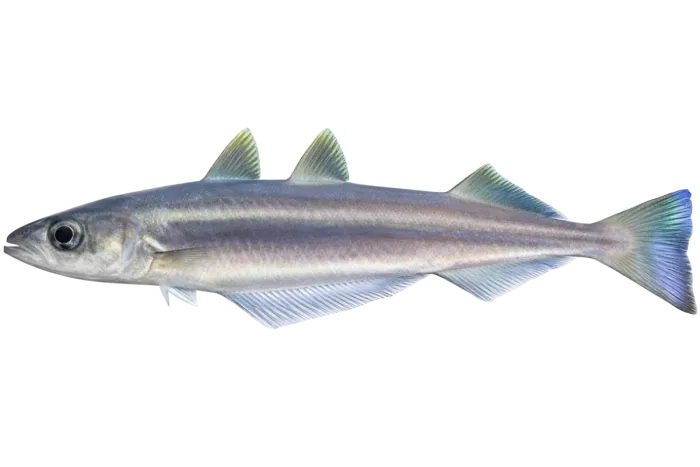 Blue Whiting
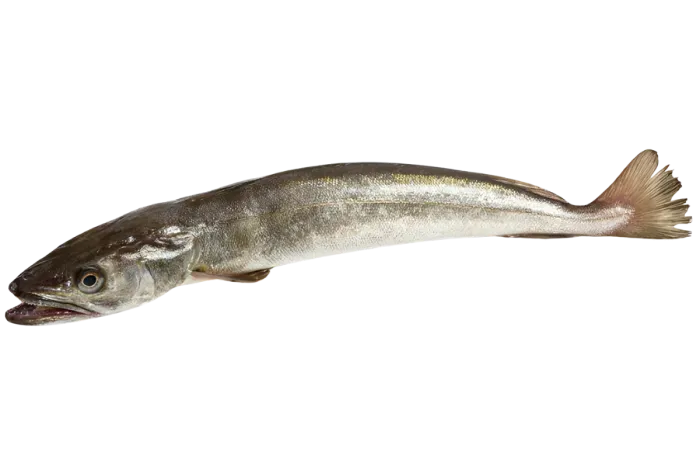 Hake
How to tell them apart
Count the fins on the back. The Blue Whiting has three small ones with gaps between them. The Hake has two, a short one in front and a long one behind. The Hake also has a large mouth with sharp teeth and grows much bigger.
Scientific name
Blue Whiting
Micromesistius poutassou
Hake
Merluccius merluccius
Also known as
Blue Whiting
Prosfygaki
Hake
Mpakaliaros, Mpakaliaraki, Ntaouki
Is it eaten?
Blue Whiting
Yes
Hake
Yes
Is it dangerous?
Blue Whiting
No
Hake
Yes
Usual size
Blue Whiting
15 to 25 cm
Hake
30 to 60 cm
Fishing season
Blue Whiting
No data
Hake
November to March
Category
Blue Whiting
Pelagic & Open Sea Fish
Hake
Sandy & Estuary Fish
Conservation status
Blue Whiting
Least Concern (LC)
Hake
Least Concern (LC)
What it looks like
Blue Whiting
The Blue Whiting, which is also commonly referred to as the Poutassou, is a small benthopelagic fish belonging to the Gadidae family. This makes it a close relative of the European Hake and the Atlantic Cod. The body is slender and elongated with a blue-grey colour on the back that gradually turns silver and ends in white on the belly. The mouth is relatively large, and the lower jaw protrudes slightly forward.
Hake
The European Hake is one of the most valuable commercial fish in the Mediterranean. The body is elongated and slender, with a silver-grey colour on the back and white on the belly. It has a large mouth with a black interior and is armed with two rows of very sharp, pointed teeth that tilt inward, preventing prey from escaping.
Where it lives
Blue Whiting
It is a deep-water fish that lives and moves at the edges of the continental shelf. During the day, it forms dense schools near the bottom at depths from 150 to 400 metres, even though it has been found as deep as 3000 metres. At night, it performs vertical migrations, rising to shallower layers of water to feed.
Hake
This is a benthic species that lives near the seabed and usually in areas with mud. The depth at which it is encountered varies by age and season, but it usually ranges from 70 to 400 metres, though it can reach as deep as 1000 metres. During the day, it remains inactive on the bottom, while at night it rises higher in the water column to hunt.
Everything about Blue Whiting Everything about Hake
More fish that get mixed up
- Albacore or Atlantic Bluefin Tuna
- Albacore or Little Tunny
- Anchovy or Pilchard
- Angular Roughshark or Spiny Dogfish
- Atlantic Bonito or Little Tunny
- Atlantic Mackerel or Chub Mackerel
- Blue Runner or Horse Mackerel
- Brill or Turbot
- Broadtail Shortfin Squid or Squid
- Brown Comber or Comber
- Comber or Painted Comber
- Conger or Eel
- Dogtooth Grouper or White Grouper
- Dogtooth Grouper or Wreckfish
- Dusky Grouper or Mottled Grouper
- Flying Fish or Flying Gurnard
- Garfish or Halfbeak
- Greater Amberjack or Leerfish
- Mediterranean Spearfish or Swordfish
- Nursehound or Small spotted Catshark
- Pilchard or Round Sardinella
- Red Mullet or Striped Red Mullet
- Stingray or Thornback Ray