
Stingray or Thornback Ray: how to tell them apart
The two fish next to each other, fact by fact.
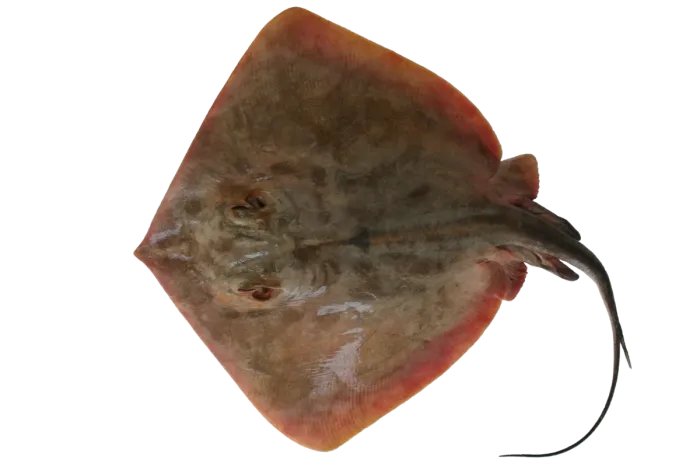 Stingray
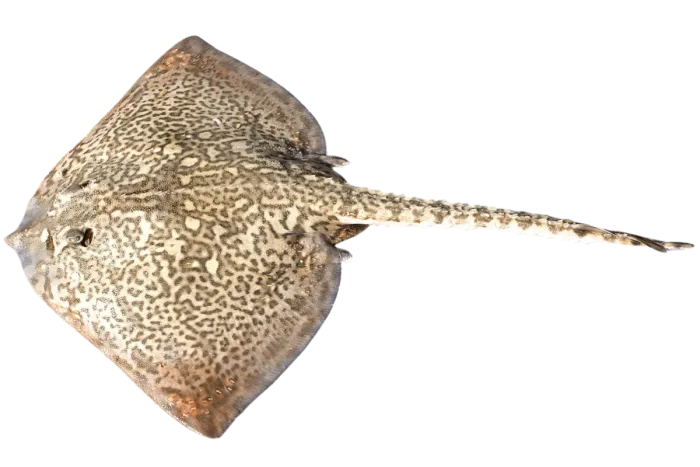 Thornback Ray
How to tell them apart
The Stingray has smooth skin and a thin tail like a whip, with a venomous sting. The Thornback Ray has its back and tail covered in thorns with broad bases, two small fins near the tip of the tail and no sting.
Scientific name
Stingray
Dasyatis pastinaca / Bathytoshia centroura
Thornback Ray
Raja clavata
Also known as
Stingray
Vati, Trygona
Thornback Ray
Ragia, Vatos, Akanthoragia
Is it eaten?
Stingray
With caution
Thornback Ray
Yes
Is it dangerous?
Stingray
Yes
Thornback Ray
No
Usual size
Stingray
30 to 45 cm
Thornback Ray
40 to 80 cm
Category
Stingray
Rays & Flatfish, Venomous & Dangerous Fish
Thornback Ray
Rays & Flatfish
Conservation status
Stingray
Vulnerable (VU)
Thornback Ray
Near Threatened (NT)
What it looks like
Stingray
The Common Stingray is a well-known cartilaginous fish in the Mediterranean. It features a flat diamond-shaped body that allows it to remain perfectly concealed when buried in the sand. Its eyes are positioned on the upper side of the head to maintain visibility while hidden, while the mouth is on the underside. The tail is long and slender, resembling a whip. In the Mediterranean, two main species are encountered.
Thornback Ray
The Thornback Ray, which is also widely known as the Thornback Skate or the Roker, is the most common and commercial species of ray in regional waters. It belongs to the Rajidae family and is often confused with the stingray, but there is a fundamental difference in safety. The Thornback Ray is harmless because it does not possess a venomous stinger on the tail.
Where it lives
Stingray
It lives strictly on the seabed, usually in sandy or muddy areas, where it can easily bury itself. It is found in very shallow coastal waters where people swim down to depths of 200 metres.
Thornback Ray
This is a benthic species that inhabits a wide variety of seabed habitats. It is encountered on sandy, muddy, and gravelly bottoms at depths ranging from 10 to 300 metres, though it is more common between 10 and 60 metres. It often remains half-buried in the sand during the day and hunts primarily at night.
Everything about Stingray Everything about Thornback Ray
More fish that get mixed up
- Albacore or Atlantic Bluefin Tuna
- Albacore or Little Tunny
- Anchovy or Pilchard
- Angular Roughshark or Spiny Dogfish
- Atlantic Bonito or Little Tunny
- Atlantic Mackerel or Chub Mackerel
- Blue Runner or Horse Mackerel
- Blue Whiting or Hake
- Brill or Turbot
- Broadtail Shortfin Squid or Squid
- Brown Comber or Comber
- Comber or Painted Comber
- Conger or Eel
- Dogtooth Grouper or White Grouper
- Dogtooth Grouper or Wreckfish
- Dusky Grouper or Mottled Grouper
- Flying Fish or Flying Gurnard
- Garfish or Halfbeak
- Greater Amberjack or Leerfish
- Mediterranean Spearfish or Swordfish
- Nursehound or Small spotted Catshark
- Pilchard or Round Sardinella
- Red Mullet or Striped Red Mullet