
Greater Amberjack or Leerfish: how to tell them apart
The two fish next to each other, fact by fact.
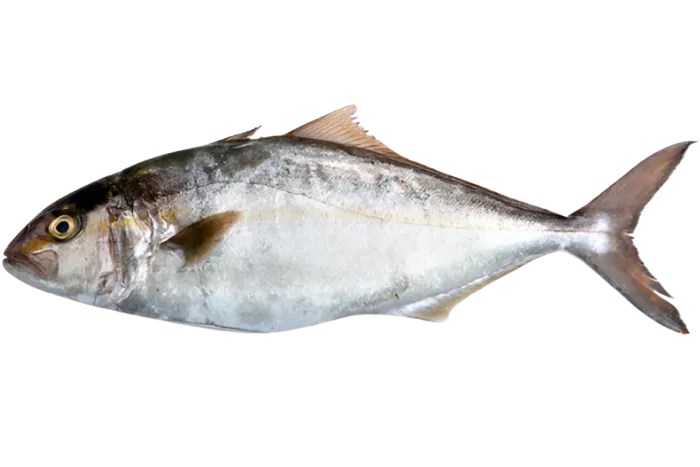 Greater Amberjack
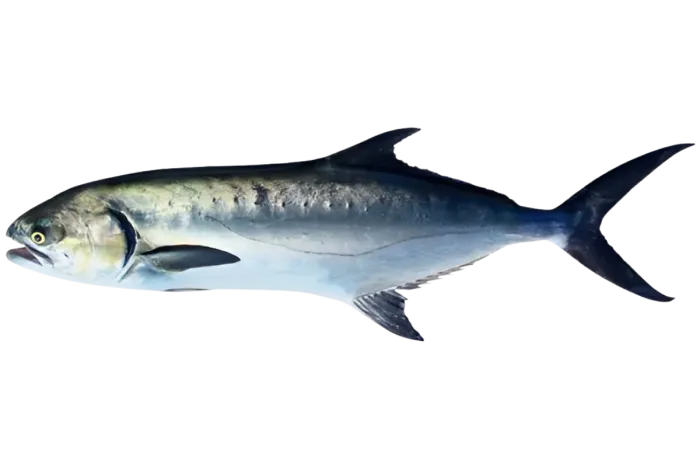 Leerfish
How to tell them apart
The Greater Amberjack has a dark slanting band from the eye towards the back and often a yellowish line along the side. The Leerfish has no yellow. It stands out for its lateral line, which makes a strong wave up and down, and for the pointed, dark tips of its back and belly fins.
Scientific name
Greater Amberjack
Seriola dumerili
Leerfish
Lichia amia
Also known as
Greater Amberjack
Magiatiko, Mineri, Manali
Leerfish
Litsa
Is it eaten?
Greater Amberjack
Yes
Leerfish
Yes
Is it dangerous?
Greater Amberjack
No
Leerfish
No
Usual size
Greater Amberjack
60 to 100 cm
Leerfish
No data
Fishing season
Greater Amberjack
April to June, September to November
Leerfish
May to June, September to December
Category
Greater Amberjack
Pelagic & Open Sea Fish
Leerfish
Pelagic & Open Sea Fish
Conservation status
Greater Amberjack
Least Concern (LC)
Leerfish
Least Concern (LC)
What it looks like
Greater Amberjack
The Greater Amberjack is undoubtedly the dominant predator of the rocky Mediterranean seabeds and belongs to the Carangidae family. Its name originates from the month of May, when large adult fish approach the shores in mass to reproduce. The body is robust and hydrodynamic, with a torpedo-shaped design for high speed and power.
Leerfish
The Leerfish is an impressive and powerful predator belonging to the Carangidae family. It is often confused with the Greater Amberjack, but clear differences distinguish them. The body is strongly compressed on the sides and appears flat, while the body of the amberjack is more rounded and torpedo-shaped.
Where it lives
Greater Amberjack
The species is benthopelagic, living near the seabed while also moving in midwater layers. Adults prefer deep waters from 20 to 70 metres, although they have been recorded at depths exceeding 300 metres. They love rocky bottoms with intense relief, drop-offs, reefs, and shipwrecks where they find abundant food.
Leerfish
This is a strictly coastal and pelagic species that enjoys shallow waters. It usually moves from the surface down to a depth of 50 metres. It is highly resilient to salinity changes and frequently enters river estuaries, lagoons, or ports to hunt schools of mullet. It prefers areas with currents and high water movement, like headlands or port entrances.
Everything about Greater Amberjack Everything about Leerfish
More fish that get mixed up
- Albacore or Atlantic Bluefin Tuna
- Albacore or Little Tunny
- Anchovy or Pilchard
- Angular Roughshark or Spiny Dogfish
- Atlantic Bonito or Little Tunny
- Atlantic Mackerel or Chub Mackerel
- Blue Runner or Horse Mackerel
- Blue Whiting or Hake
- Brill or Turbot
- Broadtail Shortfin Squid or Squid
- Brown Comber or Comber
- Comber or Painted Comber
- Conger or Eel
- Dogtooth Grouper or White Grouper
- Dogtooth Grouper or Wreckfish
- Dusky Grouper or Mottled Grouper
- Flying Fish or Flying Gurnard
- Garfish or Halfbeak
- Mediterranean Spearfish or Swordfish
- Nursehound or Small spotted Catshark
- Pilchard or Round Sardinella
- Red Mullet or Striped Red Mullet
- Stingray or Thornback Ray