
Dogtooth Grouper or White Grouper: how to tell them apart
The two fish next to each other, fact by fact.
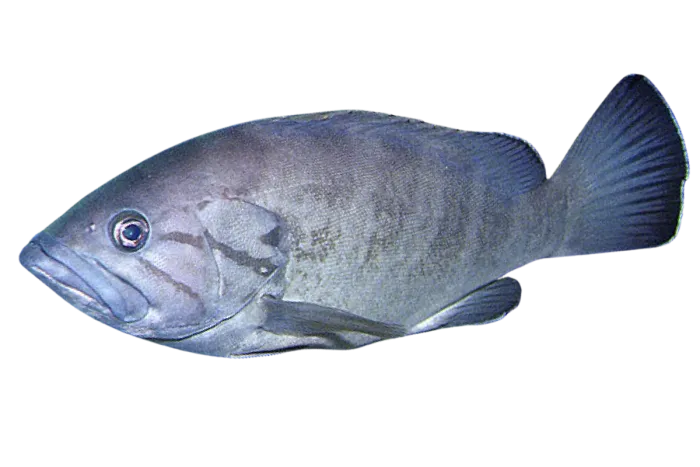 Dogtooth Grouper
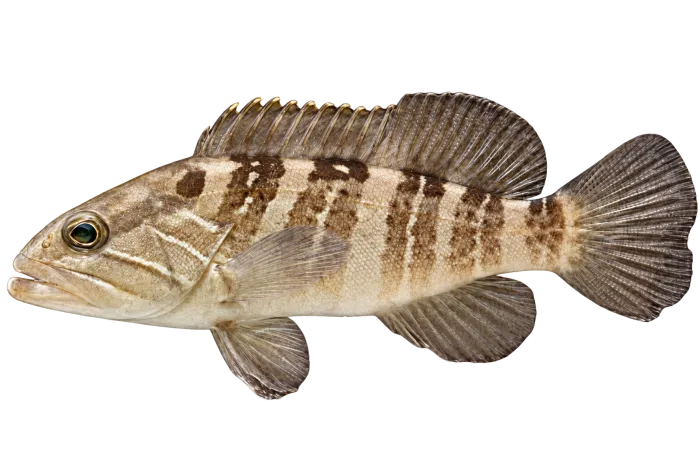 White Grouper
How to tell them apart
Look at the cheek. The White Grouper has three or four pale slanting lines on the gill cover and a slimmer, grey green body. The Dogtooth Grouper has two or three dark lines starting at the eye, a darker colour and large teeth like canines. The Dogtooth Grouper usually lives deeper.
Scientific name
Dogtooth Grouper
Epinephelus caninus
White Grouper
Epinephelus aeneus
Also known as
Dogtooth Grouper
Vlachosfyrida, Asprovlachos
White Grouper
Sfyrida
Is it eaten?
Dogtooth Grouper
Yes
White Grouper
Yes
Is it dangerous?
Dogtooth Grouper
No
White Grouper
No
Usual size
Dogtooth Grouper
No data
White Grouper
50 to 70 cm
Fishing season
Dogtooth Grouper
June to October
White Grouper
No data
Category
Dogtooth Grouper
Reef & Rocky Bottom Fish
White Grouper
Reef & Rocky Bottom Fish
Conservation status
Dogtooth Grouper
Data Deficient (DD)
White Grouper
Near Threatened (NT)
What it looks like
Dogtooth Grouper
The Dogtooth Grouper is one of the most imposing and largest representatives of the grouper family in the Mediterranean. Its scientific name translates to "canine," given its characteristic, very strong teeth that protrude from the front of its mouth. The body is robust and massive, with a huge mouth capable of swallowing large prey.
White Grouper
The White Grouper, also known as the White Rockfish or Bronze Grouper, is one of the most sought-after and delicious fish in the Serranidae family. It is famous for its delicate white meat, which many gourmets consider superior even to that of the Dusky Grouper. At the same time, it is also noted for its unique behaviour on the seabed.
Where it lives
Dogtooth Grouper
This is a fish that loves deep waters and soft seabeds. It lives almost exclusively in areas with mud or sand, at depths ranging from 30 to 400 metres. Unlike other groupers that hide among rocks, this species dominates the deep, open stretches of the continental shelf.
White Grouper
This is a benthic species that lives at depths from 20 to 200 metres. In contrast to the Dusky Grouper, which loves rocks, the White Grouper prefers soft bottoms such as sandy or muddy areas and mixed seabeds with gravel near Posidonia seagrass meadows. It is famous as the architect of the seabed because it has the unique habit of digging its own burrow under individual ledges or roots within the sand.
Everything about Dogtooth Grouper Everything about White Grouper
More fish that get mixed up
- Albacore or Atlantic Bluefin Tuna
- Albacore or Little Tunny
- Anchovy or Pilchard
- Angular Roughshark or Spiny Dogfish
- Atlantic Bonito or Little Tunny
- Atlantic Mackerel or Chub Mackerel
- Blue Runner or Horse Mackerel
- Blue Whiting or Hake
- Brill or Turbot
- Broadtail Shortfin Squid or Squid
- Brown Comber or Comber
- Comber or Painted Comber
- Conger or Eel
- Dogtooth Grouper or Wreckfish
- Dusky Grouper or Mottled Grouper
- Flying Fish or Flying Gurnard
- Garfish or Halfbeak
- Greater Amberjack or Leerfish
- Mediterranean Spearfish or Swordfish
- Nursehound or Small spotted Catshark
- Pilchard or Round Sardinella
- Red Mullet or Striped Red Mullet
- Stingray or Thornback Ray