
Broadtail Shortfin Squid or Squid: how to tell them apart
The two fish next to each other, fact by fact.
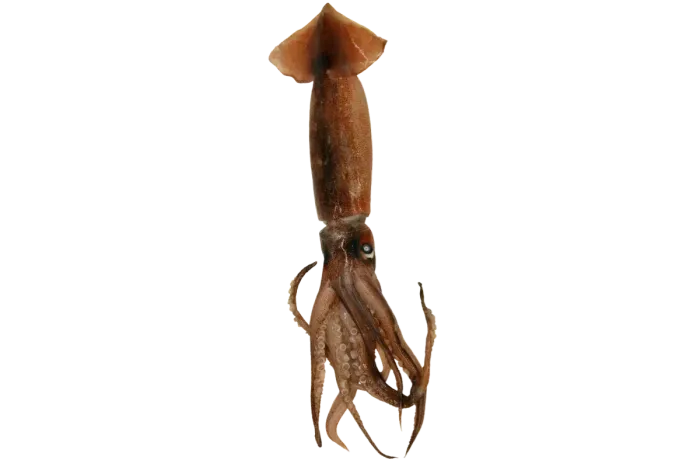 Broadtail Shortfin Squid
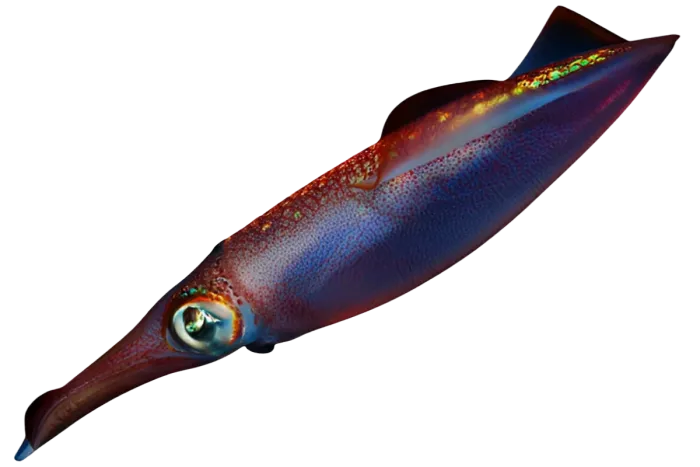 Squid
How to tell them apart
Look at the fins on the body. On the European Squid they are long and cover about two thirds of the body. On the Shortfin Squid they are short, only at the tip, and form a small arrowhead. The Shortfin Squid has tougher flesh and costs less.
Scientific name
Broadtail Shortfin Squid
Illex coindetii / Todarodes sagittatus
Squid
Loligo vulgaris
Also known as
Broadtail Shortfin Squid
Thrapsalo
Squid
Kalamari
Is it eaten?
Broadtail Shortfin Squid
Yes
Squid
Yes
Is it dangerous?
Broadtail Shortfin Squid
No
Squid
No
Usual size
Broadtail Shortfin Squid
20 to 30 cm
Squid
15 to 25 cm
Fishing season
Broadtail Shortfin Squid
October to March
Squid
October to March
Category
Broadtail Shortfin Squid
Pelagic & Open Sea Fish
Squid
Pelagic & Open Sea Fish
Conservation status
Broadtail Shortfin Squid
Least Concern (LC)
Squid
Data Deficient (DD)
What it looks like
Broadtail Shortfin Squid
The Broadtail Shortfin Squid is a cephalopod mollusc that is often confused with the common squid, even though it is a different species with distinct anatomical features. The body is cylindrical and ends in two small triangular fins at the back, which form a point resembling an arrow or the tail of a rocket. This is the primary difference from the common squid, which has much larger fins that cover most of its body.
Squid
The European Squid is the most famous and commercially significant cephalopod in the region, and it is known globally for the exceptional quality of its meat. It belongs to the Loliginidae family. The body is elongated and cylindrical, with two large lateral fins that begin at the middle of the mantle and extend to the tail, forming a rhombus.
Where it lives
Broadtail Shortfin Squid
This is a species that lives primarily in deep waters and the open sea. During the day, it remains at great depths ranging from 100 to 800 metres near the seabed. At night, it performs vertical migrations by rising toward the surface to hunt.
Squid
It lives mainly near the coast as a neritic species on sandy and muddy seabeds as well as within Posidonia seagrass meadows. During the day, it remains near the bottom at depths from 10 to 100 metres, although it can reach 500 metres. At night, it rises toward the surface to hunt.
Everything about Broadtail Shortfin Squid Everything about Squid
More fish that get mixed up
- Albacore or Atlantic Bluefin Tuna
- Albacore or Little Tunny
- Anchovy or Pilchard
- Angular Roughshark or Spiny Dogfish
- Atlantic Bonito or Little Tunny
- Atlantic Mackerel or Chub Mackerel
- Blue Runner or Horse Mackerel
- Blue Whiting or Hake
- Brill or Turbot
- Brown Comber or Comber
- Comber or Painted Comber
- Conger or Eel
- Dogtooth Grouper or White Grouper
- Dogtooth Grouper or Wreckfish
- Dusky Grouper or Mottled Grouper
- Flying Fish or Flying Gurnard
- Garfish or Halfbeak
- Greater Amberjack or Leerfish
- Mediterranean Spearfish or Swordfish
- Nursehound or Small spotted Catshark
- Pilchard or Round Sardinella
- Red Mullet or Striped Red Mullet
- Stingray or Thornback Ray