
Dusky Grouper or Mottled Grouper: how to tell them apart
The two fish next to each other, fact by fact.
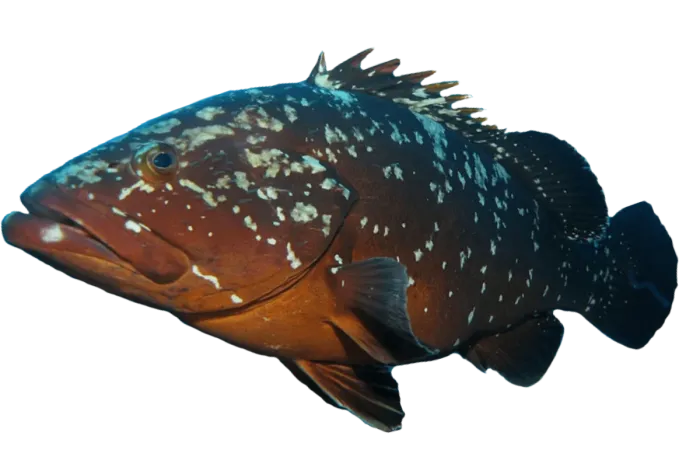 Dusky Grouper
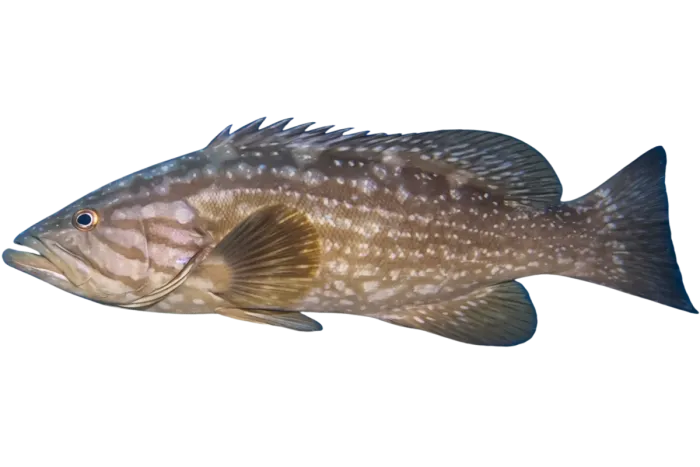 Mottled Grouper
How to tell them apart
The Dusky Grouper is stocky, dark brown with irregular pale blotches, and its tail is rounded. The Mottled Grouper is longer, reddish brown, with a lower jaw that juts out and a tail cut straight.
Scientific name
Dusky Grouper
Epinephelus marginatus
Mottled Grouper
Mycteroperca rubra
Also known as
Dusky Grouper
Rofos, Orfos
Mottled Grouper
Pigka, Kokkinovlachos
Is it eaten?
Dusky Grouper
Yes
Mottled Grouper
Yes
Is it dangerous?
Dusky Grouper
No
Mottled Grouper
No
Usual size
Dusky Grouper
No data
Mottled Grouper
40 to 60 cm
Fishing season
Dusky Grouper
No data
Mottled Grouper
May to October
Category
Dusky Grouper
Reef & Rocky Bottom Fish
Mottled Grouper
Reef & Rocky Bottom Fish
Conservation status
Dusky Grouper
Vulnerable (VU)
Mottled Grouper
Least Concern (LC)
What it looks like
Dusky Grouper
The Dusky Grouper which is also frequently referred to as the Yellowbelly Grouper or the Squaretail Grouper is the undisputed king of the rocky Mediterranean seabeds and the most iconic member of the Serranidae family. It is a fish with an imposing presence and a bulky and heavy body along with a huge head with fleshy lips.
Mottled Grouper
The Mottled Grouper, which is also commonly referred to as the Red Grouper or the Comb Grouper, is a beautiful and impressive fish of the Serranidae family. It is a close relative of the Dusky Grouper and the Goldblotch Grouper. Although it resembles the Dusky Grouper, it possesses clear differences that make it a more athletic and agile hunter.
Where it lives
Dusky Grouper
It is a purely benthic, territorial species that lives exclusively on rocky bottoms. It carefully chooses a permanent home, usually a spacious cave or crevice among the rocks with many escape routes. The fish rarely moves away from its home, which it defends with passion. It is encountered at depths from 10 to 50 metres, although large individuals can descend as far as 200 metres.
Mottled Grouper
This is a bottom-dwelling species that lives mainly on rocky bottoms, but with an important distinction. Unlike the Dusky Grouper, which is static and stays near its cave, the Mottled Grouper is much more mobile. It likes to hover and hunt actively in the midwaters several metres above the seabed.
Everything about Dusky Grouper Everything about Mottled Grouper
More fish that get mixed up
- Albacore or Atlantic Bluefin Tuna
- Albacore or Little Tunny
- Anchovy or Pilchard
- Angular Roughshark or Spiny Dogfish
- Atlantic Bonito or Little Tunny
- Atlantic Mackerel or Chub Mackerel
- Blue Runner or Horse Mackerel
- Blue Whiting or Hake
- Brill or Turbot
- Broadtail Shortfin Squid or Squid
- Brown Comber or Comber
- Comber or Painted Comber
- Conger or Eel
- Dogtooth Grouper or White Grouper
- Dogtooth Grouper or Wreckfish
- Flying Fish or Flying Gurnard
- Garfish or Halfbeak
- Greater Amberjack or Leerfish
- Mediterranean Spearfish or Swordfish
- Nursehound or Small spotted Catshark
- Pilchard or Round Sardinella
- Red Mullet or Striped Red Mullet
- Stingray or Thornback Ray